Feature iterations break down large projects into smaller cycles - plan, build, test, deploy - allowing teams to release basic versions quickly, gather user feedback, and improve over time. Low-code platforms make this process faster with visual tools, drag-and-drop interfaces, and pre-built templates, cutting development time by up to 90%. By 2025, over 90% of organizations are expected to adopt proprietary low-code solutions.
Key Takeaways:
- Start Small: Focus on minimal viable features to validate ideas.
- User Feedback: Collect and analyze feedback early and often.
- Pre-Built Tools: Use templates and components to save time.
- Testing: Continuous testing ensures quality and avoids issues.
- Governance: Set clear rules, roles, and documentation to maintain control.
A phased roadmap is essential:
- Prove value with a pilot project.
- Expand with reusable components.
- Scale with a Center of Excellence (COE).
This approach ensures faster development, better collaboration, and scalable solutions while minimizing risks like technical debt and vendor lock-in.
Ship Mobile Apps Faster with Your Own Low-Code System
sbb-itb-33eb356
Planning and Setup for Iterations
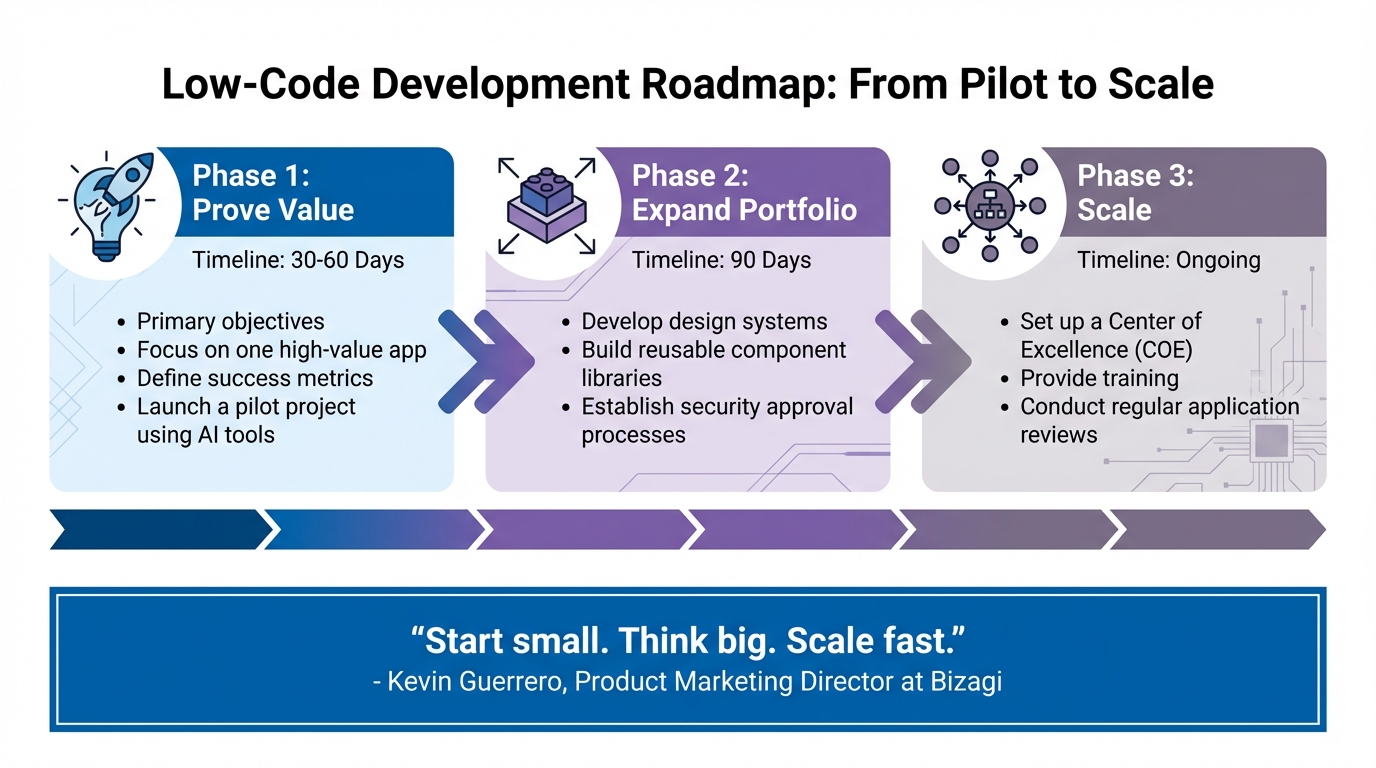
Three-Phase Low-Code Development Roadmap with Timeline and Objectives
Define Clear Objectives and Features
Before diving into low-code tools, get all stakeholders on the same page. Host workshops with IT managers, executives, and the end users of your application. These sessions are invaluable for identifying pain points and ensuring your project aligns with broader strategic goals. Skip lengthy requirements documents - what matters is clarifying the problems you're solving and who benefits from the solution.
Focus on use cases that deliver measurable results. For instance, TTMS implemented a healthcare patient referral system in 2026 using PowerApps integrated with Epic EHR and SQL Server. By automating data validation and removing manual data entry, they reduced referral processing time from 6 days to just 8 hours. Aim for this kind of impactful outcome.
Prioritize features that pack a punch. Target those that maximize business value with minimal effort and risk - like automating repetitive tasks or addressing gaps in workflows. Establish success metrics from the start. These might include development speed, user satisfaction, error rates, or feature adoption rates. These numbers will guide your iterations and help you demonstrate value to leadership.
Governance is key from day one. Define clear rules about who can build applications, the standards they must follow, and approved data sources. This ensures your low-code projects scale smoothly. Also, plan for regular feedback loops early on by creating a visual demo or prototype to gather user input on functionality and missing features. The goal isn’t perfection - it's adaptability. With clear objectives in place, outline your phased development roadmap to guide your iterative process.
Create a Development Roadmap
Organize your roadmap into three distinct phases. Each phase builds on the last, starting with a pilot project and scaling to organizational-wide adoption.
| Roadmap Phase | Timeline | Primary Objectives |
|---|---|---|
| Phase 1: Prove Value | 30–60 Days | Focus on one high-value app; define success metrics; launch a pilot project using free AI tools. |
| Phase 2: Expand Portfolio | 90 Days | Develop design systems; build reusable component libraries; establish security approval processes. |
| Phase 3: Scale | Ongoing | Set up a Center of Excellence (COE); provide training; conduct regular application reviews. |
Start with a low-risk, high-reward project that can deliver quick wins. This builds confidence across the organization without jeopardizing critical operations. As Kevin Guerrero, Product Marketing Director at Bizagi, advises:
"Start small. Think big. Scale fast".
To streamline collaboration between business and IT teams, use model-driven development and visual flowcharts. These tools replace the need for drawn-out requirements documents and create a shared language. Pair your roadmap with proven frameworks like SCRUM to manage the fast-paced nature of low-code development. At every milestone, track KPIs such as time from concept to deployment, user satisfaction, post-deployment error rates, and feature adoption.
Best Practices for Feature Iterations
Start Small: Build Minimal Viable Features
Think of your first iteration as a tool to validate ideas, not a finished product. The main objective is to test your riskiest assumptions about how users interact with your feature, focusing on key workflows and actions. At this stage, skip over scaling, fine-tuning, and edge cases. Instead, design for the "happy path" - the ideal user journey. If users frequently encounter obstacles or need assistance, it's a sign the feature requires refinement.
Using visual modeling tools can make this process more inclusive, allowing non-technical stakeholders to weigh in on whether the application solves the right problem. Financially, this approach is also more efficient. Developing a low-code MVP typically costs between $20,000 and $45,000, compared to $40,000 to $80,000 for custom development. Plus, it helps sidestep the common pitfall of 60% of startups that fail due to a lack of market demand. To gauge success, track behavior-based metrics like activation rates, retention, and time-to-value. These indicators reveal whether you're addressing a real user need.
Gather User Feedback Early and Often
Feedback is most valuable when gathered consistently throughout development. Use structured touchpoints like product demos, beta testing, and post-update reviews to collect insights. But don’t just rely on what users say - observe their actions. Metrics like clicks, task completion rates, and drop-off points can uncover friction that verbal feedback might miss. Early release of visual prototypes, even in a rough state, can highlight missing features and validate functionality before significant resources are invested.
Collaboration between business experts and IT, often referred to as "fusion teams", can improve development accuracy by 35.4% by creating a shared understanding of requirements. This is especially relevant as 75% of large organizations are expected to adopt at least four low-code tools for IT and citizen development initiatives. To manage the flood of feedback, connect your tools to CRM or project management systems. This integration provides developers with full customer context and tracks which suggestions are implemented. Set clear goals for each iteration based on user input, like improving mobile navigation or simplifying forms. Once feedback is validated, prioritize using pre-built components to speed up development while maintaining consistency.
Use Pre-Built Templates and Components
After validating features and gathering feedback, using pre-built components can significantly speed up development - by as much as 90% compared to traditional coding. Drag-and-drop widgets, customizable forms, and charts ensure consistency across updates. Pre-configured data models for tasks like managing customer databases or tracking inventory remove the need for manual setup.
Centralized component libraries are invaluable. For example, if you improve a validated address input field, updates can automatically apply to all applications using that component. Workflow templates for common processes like approval chains or document routing save time by eliminating the need to configure logic from scratch. Integration connectors for platforms like Salesforce, SAP, or Microsoft Teams allow seamless data flow without requiring custom code.
While templates can provide a major head start, balance is key. Over-customizing a generic template can erase the time-saving benefits. Choose templates that align with your existing systems to ensure smooth integration. With 80% of low-code users expected to come from outside IT departments by 2026, standardized components will play a critical role in maintaining quality across projects.
Testing, Optimization, and Governance
Test Continuously During Iterations
Testing should be an integral part of every development cycle to catch issues early. A continuous integration/continuous delivery (CI/CD) pipeline ensures automated testing happens each time changes are made, helping to identify bugs before they impact users.
Use a mix of testing methods: unit tests for individual modules, integration tests to validate how components work together, and User Acceptance Testing (UAT) to ensure the application meets business goals. AI-powered tools can even adjust tests automatically when changes in the platform or user interface occur.
"Low-code test automation is what makes it possible to achieve high test coverage at the volume and pace modern development demands." - Team Copado
Focus your automation efforts on tasks that are repeatable, stable, and high-volume, as these provide the best return. Write test cases in clear, straightforward language so non-technical stakeholders can easily understand them. To measure success, track metrics like development speed, post-deployment error rates, and feature adoption.
Once testing is in place, the next priority is improving performance.
Optimize for Performance
Performance issues can drive users away. For example, Amazon reported that just a 100ms delay in page load times caused a 1% drop in revenue. Prioritizing speed from the start ensures your application remains competitive and user-friendly.
Identify performance bottlenecks such as heavy database queries, large file uploads, or synchronous API calls that slow down the user interface. Profiling tools can help pinpoint the exact areas causing delays, saving time compared to guessing. To improve efficiency, consider caching frequently accessed data and precomputing complex calculations to avoid redundant work. Address database problems like missing indexes or expensive joins, and use tools like Redis or Memcached to handle frequently used data.
For heavy processing tasks, convert synchronous operations into asynchronous jobs with status updates. This keeps the interface responsive and prevents shared resources from being overwhelmed. For example, in 2025, cybersecurity firm KnowBe4 used Sedai's autonomous optimization on their Amazon ECS infrastructure to reduce latency, improve availability, and lower costs - all without needing additional staff.
"Performance now has to be smart, not just fast. That's where AI-driven optimization tools come in. They don't just flag slow endpoints; they predict and prevent them." - Hari Chandrasekhar, Content Writer, Sedai
Include load and stress testing in your CI/CD pipeline to ensure your application can handle real-world demands. Set per-app and per-tenant quotas to prevent a single misstep from destabilizing the platform.
Once performance is optimized, maintaining quality through documentation and governance is essential.
Maintain Documentation and Governance
Fast-paced development requires solid governance to avoid chaos. Yet, only 31% of companies using low-code technology have established governance frameworks, leaving many exposed to security and maintenance risks.
Separate development, testing, and production environments to minimize risks and ensure smooth releases. Implement role-based access control (RBAC) to define clear responsibilities: "Makers" create features, "Reviewers" validate them, and "Admins" enforce policies. Use version control to track changes to workflows or data models, making it easier to reverse problematic updates.
Keep documentation up to date with user guides, process flows, API references, and troubleshooting manuals. This not only helps teams work efficiently but also supports compliance with regulations like SOC 2 and GDPR through automated audit trails.
Establish a shared library of pre-approved components - such as forms, rules, and processes - to save time and maintain consistency across teams. Require mandatory approval workflows to validate logic, security, and usability before deploying apps to production. Start with smaller, less critical projects to refine your governance approach before scaling up to more complex initiatives.
"Low-code governance is about empowering innovation responsibly... ensuring low-code doesn't become low-control." - Nutrient
Conclusion and Resources
Key Takeaways
When working with low-code platforms, having a phased approach is essential. Begin with minimal viable features to achieve quick wins and build scalable confidence. Bringing in fusion teams can improve development accuracy by 35.4%, while shared libraries help save time and ensure consistency across different iterations.
Testing should happen early and often - covering unit, integration, and user acceptance testing (UAT) - to catch issues before they escalate. Keep an eye on metrics like development speed, error rates, and feature adoption to measure your progress. Governance frameworks are also critical. They should include clear roles, version control, and approval workflows to maintain security and streamline maintenance.
"Start small. Think big. Scale fast." - Kevin Guerrero, Product Marketing Director, Bizagi
Looking ahead, by 2026, 75% of large organizations are expected to use at least four low-code tools for both IT and citizen development initiatives. The market itself is projected to hit $31.59 billion by 2026, growing at a compound annual growth rate (CAGR) of 20.12%. These trends underline how central low-code platforms have become to modern development strategies.
By adopting these practices, your iterative development can stay adaptable, efficient, and ready to scale.
Find Low-Code Platforms
Choosing the right low-code platform is a critical step. Look for tools that offer reusable components, flexible deployment options (cloud-based or self-hosted), and seamless integration with your existing systems. Platforms with built-in governance features - like role-based access control (RBAC), single sign-on (SSO), and audit logs - are ideal, especially if they don’t require additional fees for these features.
For a comprehensive resource, check out the Low Code Platforms Directory at https://lowcodeplatforms.org. This site provides a curated list of platforms with a filtering system to help you find tools tailored to your needs, whether you’re focused on AI integration, automation, CRM, or web development. It’s a great starting point to identify platforms that align with your project’s requirements and support iterative workflows effectively.
FAQs
How do I pick the right pilot app for low-code iterations?
Start with small, low-stakes projects that allow for quick results and carry little risk. These could involve automating repetitive tasks or streamlining internal workflows, making it easier to test and gather feedback quickly. Opt for platforms that align with agile development practices, enabling you to refine and adjust through iterative testing. This method not only simplifies pilot testing but also makes scaling up more manageable while directly tackling specific challenges.
Which KPIs best prove each iteration is working?
Key performance indicators (KPIs) that highlight the success of an iteration include customer feedback, user engagement, and the achievement of practical results or quick wins. These metrics help gauge how effectively iterative development meets stakeholder expectations and delivers measurable progress.
How can I prevent technical debt and lock-in as we scale?
To sidestep technical debt and vendor lock-in in your low-code projects, prioritize governance, version control, and simplicity from the start.
- Governance: Establish clear guidelines to keep your projects organized and scalable as they grow. This ensures consistency and prevents chaos as more users and applications are added.
- Version Control: Implement tools to track changes effectively. This allows your team to manage updates and rollbacks without losing critical work.
- Start Simple: Tackle small, low-risk projects first. This approach helps you achieve quick wins and keeps early efforts manageable, avoiding unnecessary complexity.
Make it a habit to regularly assess technical debt. By staying proactive, you can maintain scalable and maintainable applications as your low-code efforts expand.