Low-code platforms are changing how businesses build software by enabling employees without coding skills - called citizen developers - to create applications using drag-and-drop tools. These platforms remove the need for traditional programming, allowing faster app development, reduced costs, and improved collaboration between IT and business teams.
Key takeaways:
- Citizen Developers: Non-technical employees use low-code tools to solve department-specific problems.
- Faster Development: Apps can be built 5–10x faster than traditional methods, cutting months of work to weeks or days.
- Cost Savings: Companies report a 40% reduction in software development costs.
- Collaboration: IT oversees security and governance, while business users focus on app logic, creating "fusion teams."
- Market Growth: The low-code market hit $32 billion in 2025 and is projected to exceed $65 billion by 2028.
Low-code platforms also integrate AI to simplify tasks, offer pre-built templates, and connect easily with enterprise systems like Salesforce or SAP. While they accelerate innovation, challenges like governance, scalability, and security require careful management. With the right platform, training, and oversight, low-code empowers employees to solve problems efficiently while IT ensures safety and scalability.
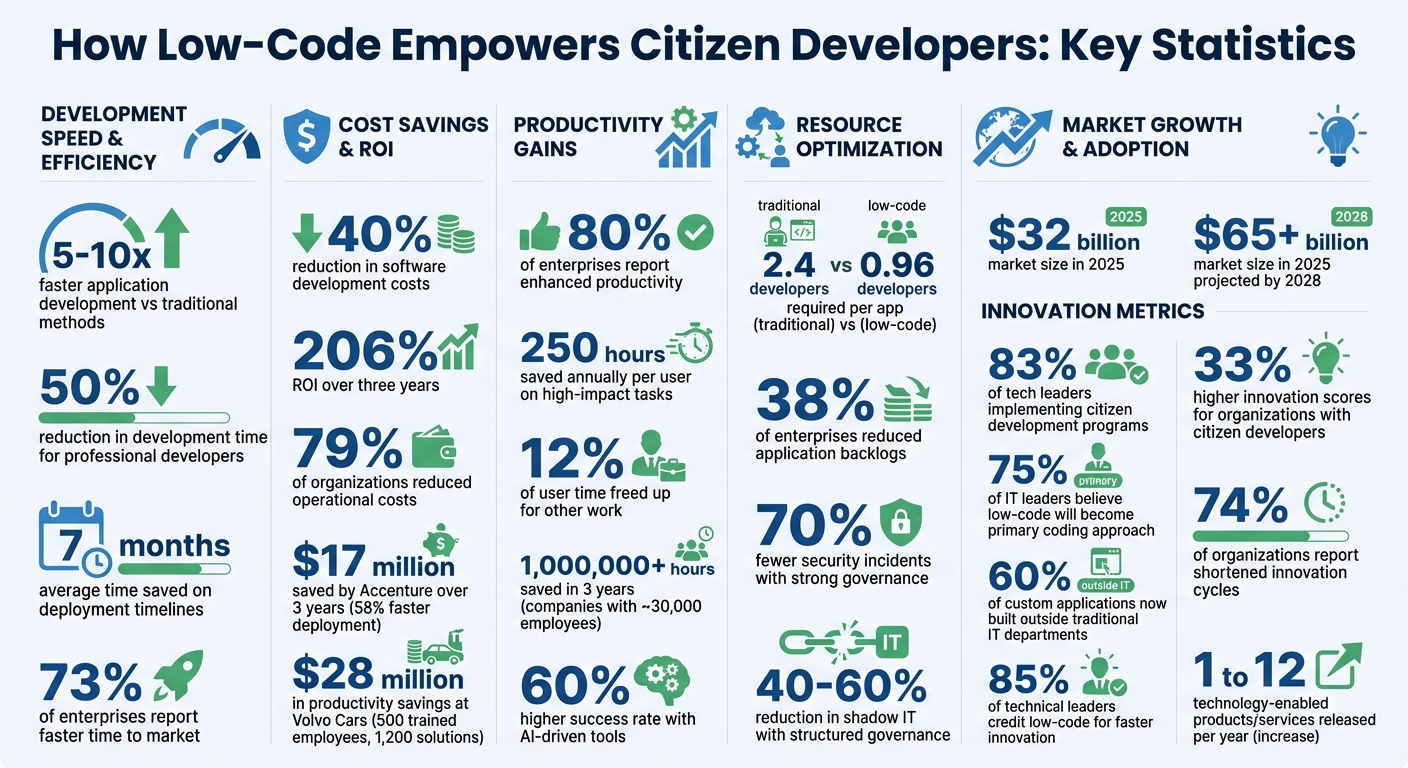
Low-Code Platform Benefits: Key Statistics on ROI, Productivity, and Market Growth
Intro to Low Code Solutions and Citizen Developers
sbb-itb-33eb356
How Low Code Platforms Enable Citizen Developers
Low-code platforms are transforming how business applications are built. By replacing traditional coding with drag-and-drop interfaces and pre-built components, these platforms remove technical barriers, making it easier for non-developers to create functional tools.
Modern platforms go a step further with AI-assisted capabilities. For instance, users can simply describe what they need in plain language - something like, "Create a workflow to track customer complaints" - and the platform generates a prototype automatically. This integration of AI complements the seamless connections these platforms offer with enterprise systems.
One standout feature is the ability to connect with systems like SAP, Salesforce, and Odoo. Business users can pull data from these systems and design workflows without needing to understand complex APIs or database structures. AI assistants further enhance usability by translating technical error messages into plain language, minimizing the need for IT support.
Even with this increased accessibility, IT teams maintain oversight through governance tools like sandboxes and role-based access controls. These measures ensure citizen developers can innovate within a secure framework, keeping data integrity and security intact. This balance empowers employees to create solutions while mitigating risks tied to unmanaged "shadow IT."
Faster Development and Lower Costs
Low-code platforms dramatically speed up development timelines. Applications that used to take months to build can now be completed in weeks - or even days - thanks to reusable templates and visual builders that eliminate repetitive coding tasks. In fact, these platforms allow applications to be deployed 5 to 10 times faster than traditional methods.
A great example of this is Aberdeen City Council, which shifted to a citizen development model. Previously, projects sat in an 18-month IT queue; now, applications are built in just two weeks. Similarly, Accenture reported cutting deployment times for business applications by 58%, saving $17 million over three years.
Better Collaboration Between IT and Business Teams
Low-code platforms also bridge the gap between IT and business teams. They encourage the formation of "fusion teams", where technical experts and business professionals collaborate closely. IT handles complex integrations and technical oversight, while business users focus on requirements and application logic. This shared environment reduces the miscommunication that often arises from lengthy and unclear requirement documents.
These fusion teams aren't just about faster development - they also drive innovation. Take Volvo Cars, for example. They trained over 500 employees, referred to as "makers", to use the Power Platform. These makers created 1,200 solutions, generating $28 million in productivity savings over three years. As Kissflow notes:
"Citizen development multiplies IT's impact. Instead of IT building everything, IT creates the platform and standards that enable others to build safely."
Encouraging Problem-Solving and New Ideas
When employees have the tools to build their own applications, they can address specific challenges that IT might not prioritize. These could include workflows for HR onboarding, marketing approvals, or sales follow-ups - tasks that often create everyday bottlenecks.
For instance, the Coca-Cola Bottlers' Association used low-code tools to develop 120 applications in just 18 months, cutting solution delivery times by 80%. This approach not only streamlines operations but also sparks innovation. Studies show organizations that empower citizen developers score 33% higher on innovation metrics. Additionally, a decentralized approach to app creation is becoming the norm, with 60% of custom applications now being built outside traditional IT departments.
Research Findings on Low Code Adoption
Higher Productivity and Efficiency
Low-code platforms are transforming workplace productivity. A significant 80% of enterprises report enhanced overall productivity after adopting these tools. For individual users, this translates to saving up to 250 hours annually on high-impact tasks, freeing up 12% of their time for other valuable work. When scaled across large organizations, the impact is massive. For instance, companies with around 30,000 employees have reported saving over 1,000,000 hours within three years.
Cost efficiency is another major benefit. 79% of organizations have reduced operational costs post-implementation. By distributing development tasks across a broader workforce, low-code platforms help cut down application backlogs - 38% of enterprises have successfully reduced their backlogs. Traditional app development typically requires 2.4 developers per application, but low-code slashes this to just 0.96 developers. As one product owner in the energy sector noted:
"Power Apps allows for faster application development because end-users don't waste time waiting for a high-code app to be developed or spend time on inefficient processes."
The financial returns are equally impressive. Organizations using low-code platforms have achieved a 206% ROI over three years. With the addition of AI-driven tools like Copilot, developers are seeing a 60% higher success rate in building applications. These tools not only boost efficiency but also enable businesses to adapt quickly to changing market demands.
Faster Response to Market Changes
Speed is another key advantage of low-code platforms. 73% of enterprises report faster time to market, with an average of 7 months shaved off deployment timelines for new products and services. This agility is critical in today’s competitive landscape, and 85% of technical leaders credit low-code with enabling faster innovation. Additionally, 74% of organizations say it shortens their innovation cycles.
The results speak for themselves: companies have gone from releasing just 1 to 12 technology-enabled products or services per year. Professional developers are leveraging low-code to cut development time by 50%, gaining a significant competitive edge. The integration of AI with low-code platforms amplifies this advantage, with 85% of enterprises stating that this combination accelerates innovation. Looking to the future, 75% of IT leaders believe low-code will become the primary approach to coding, signaling a major shift in software development practices.
Challenges and Limitations of Low Code Platforms
Governance and Security Issues
Low-code platforms promise faster development, but they also come with governance and security challenges. Non-technical users, often called citizen developers, may unintentionally violate compliance standards like HIPAA, GDPR, or PCI DSS by mishandling encryption, granting excessive privileges, or improperly storing sensitive data. As Tom Nolle from TechTarget highlights:
"Citizen development projects can inadvertently breach security and governance requirements. Line-of-business (LOB) workers neither set nor pay particular attention to IT policies."
Unregulated citizen development can lead to undocumented or abandoned applications, which become a headache for IT teams when their creators leave. Companies with strong governance protocols report 70% fewer security incidents and reduce remediation costs by 60% compared to those relying on ad hoc methods. Furthermore, structured governance programs can cut shadow IT by 40–60%.
These governance challenges are only part of the story - scaling and performance issues also come into play as applications grow.
Scalability and Performance Issues
What starts as a simple departmental tool can quickly evolve into a critical system, often without the necessary engineering foundation. Low-code platforms can struggle with scalability due to runtime overhead and inefficiencies in abstraction layers, making them unsuitable for high-performance or latency-sensitive tasks. Without technical optimizations like query tuning, caching, or pagination, these apps often slow down and may even compromise data integrity as usage grows.
Another issue arises with bidirectional data flows, which can lead to conflicts or data corruption if transaction management isn't handled properly. Sandeep Kumar Jangam notes:
"LCNC solutions can support small to medium-scale workloads, but expanding to enterprise workloads comes with design concerns regarding the ability to handle a greater level of concurrency, manage intra-replication transactions, and compliance with regulations."
Clearly, scalability isn't just about performance - it also requires thoughtful design and robust management practices.
Managing Empowerment and IT Oversight
As applications scale and performance challenges mount, organizations must establish clear boundaries between citizen development and IT oversight. Many companies restrict citizen developers to creating non-critical apps - those with fewer than 100 users or no sensitive data - while reserving critical systems for IT teams.
Fusion teams, which blend citizen developers with IT professionals, offer a way to balance innovation with control. IT's role is shifting from gatekeeping to providing secure and scalable platforms that empower innovation. As the ECOSIRE Research and Development Team puts it:
"Governance isn't bureaucracy. It's risk management that enables innovation safely."
To maintain this balance, organizations can require milestone reviews before key transitions, such as connecting to enterprise data or deploying to production. IT teams can also provide pre-approved components for complex or risky functions like payment processing or data synchronization, ensuring that citizen developers can innovate without compromising security or performance.
These strategies help organizations harness the creativity of citizen developers while maintaining the necessary technical and risk management standards.
Getting Started with Low Code Platforms
Getting the most out of citizen development begins with choosing the right platform, setting up strong governance, and providing thorough training.
Choosing the Right Low Code Platform
Start by identifying your main goal - whether it’s building internal apps, automating workflows, creating customer portals, or quickly prototyping ideas. Then, consider your team’s technical skills and look for a platform that integrates smoothly with systems like SAP, Salesforce, or Odoo while meeting your security and compliance requirements.
The Low Code Platforms Directory is a great resource. It lets you filter platforms based on specific needs, such as AI capabilities, automation tools, or CRM features, making it easier to find the best fit for your organization.
Expect costs to range between $10 and $50 per user monthly, with additional training fees between $500 and $2,000 per person. These expenses can deliver quick returns. Companies with active citizen development programs have reported cutting software development costs by an average of 40%.
After selecting your platform, the next step is to establish a solid governance framework.
Creating a Governance Framework
Surprisingly, only 31% of low-code users have formal governance guidelines in place. This makes setting up a structured governance framework essential for managing security risks and ensuring proper oversight. A good approach is to use tiered guardrails: lighter oversight for prototypes and departmental tools, and stricter controls for critical business applications.
Many organizations find success with a Center of Excellence (CoE) model. This centralizes platform management, security standards, and shared resources, while still allowing business teams to handle their specific needs. Pairing this with fusion teams - where IT developers collaborate with business experts - helps maintain both speed and quality. As Robert Huisintveld from CLEVR explains:
"When executed well, governance can actually speed up development... it's cheaper and faster to fix errors before they're written into an application".
Practical steps include implementing Data Loss Prevention (DLP) policies to manage data flow, using separate sandbox and production environments, and creating a library of pre-approved templates. Automating tasks like enforcing naming conventions, triggering approval requests for risky integrations, and activity logging can make governance even smoother.
Once governance is in place, focus shifts to training and supporting citizen developers.
Training and Supporting Citizen Developers
Over 80% of tech leaders recognize the value of citizen development programs for driving digital transformation. But success depends on proper training. A tiered certification system can help - starting with "basic builders" for internal dashboards and progressing to "advanced app owners" for more complex applications. This approach manages both risk and skill development effectively.
Training should cover platform fundamentals, data security, authentication, authorization, and escalation protocols. A great example is Virgin Voyages. In May 2025, they trained 10 semi-technical builders who, after just two days of training, delivered eight production applications within 30 days - no traditional developers or SQL experience required.
Support systems are equally important. Establish a CoE to provide templates, best practices, and regular office hours for questions. Encourage collaboration by creating low-code guilds across departments and pairing new developers with experienced mentors. Additionally, sandbox environments allow for safe experimentation without affecting live systems. As ToolJet notes:
"The organizations seeing the greatest ROI from low-code are not those that replaced their development teams, they're the ones that used low-code to amplify what their teams could deliver".
Conclusion and Future of Low Code
Low-code platforms are redefining how organizations approach innovation by shifting IT's role from gatekeeper to enabler. This shift allows business experts to take charge of creating solutions, cutting development costs by 40% and speeding up deployment by as much as 10×. With 83% of tech leaders already implementing citizen development programs, the impact is undeniable - low-code has made large-scale innovation a reality.
Looking ahead, AI is set to play an even bigger role. By 2028, 75% of enterprise software engineers are expected to use AI code assistants, while 15% of daily business decisions will be handled by agentic AI. Features like natural language prompts and "vibe coding" are making it easier than ever to build sophisticated applications, even for those without technical expertise. The market reflects this rapid growth: from $32 billion in 2025, the low-code market is projected to surpass $65 billion by 2028.
To thrive in this evolving landscape, businesses need to select the right platform, establish strong governance, and invest in training. The fusion team model, which brings together IT and business users, continues to deliver the best results. As a representative from ToolJet noted, low-code enhances team productivity rather than replacing traditional developers.
Finding the right platform can feel overwhelming, but resources like the Low Code Platforms Directory simplify the process. Whether you're looking for AI capabilities, automation tools, CRM features, or enterprise system integrations, this directory helps match platforms to your specific needs, ensuring they align with your governance and infrastructure.
The real question isn't whether low-code and citizen development will shape your organization's future - it’s whether you’ll guide this transformation with proper structure or let it unfold without oversight. With the right tools and strategy, low-code empowers business users to drive innovation while IT focuses on critical areas like architecture, security, and complex integrations. Start exploring how low-code can power your organization's future by visiting the Low Code Platforms Directory today.
FAQs
What should IT govern vs. what can citizen developers build on their own?
IT's role should center on governance by establishing clear security protocols, architectural standards, and access controls. These measures help maintain compliance and protect system integrity, reducing risks like tool sprawl or integration challenges. Within these boundaries, citizen developers can take the lead on creating apps tailored to specific needs, such as process automations or prototypes. However, IT should retain control over critical systems that demand higher levels of security or scalability.
How do you prevent low-code apps from becoming insecure “shadow IT”?
To keep low-code apps from turning into insecure "shadow IT", it's crucial to use governed low-code platforms. These platforms offer centralized tools for management, visibility, and control, making it easier to enforce security policies, track usage, and ensure compliance with organizational standards.
Beyond the platform itself, set up clear guidelines and approval processes for citizen developers. Provide training to ensure they understand best practices and potential risks. Regular audits, automated security checks, and seamless integration with existing security systems can further minimize risks while allowing innovation to thrive without compromising security.
When does a low-code app outgrow the platform’s scalability or performance limits?
When a low-code app faces large-scale enterprise workloads, it can sometimes hit the limits of a platform's scalability or performance. Common challenges include handling high concurrency, managing intra-replication transactions, and avoiding bottlenecks caused by platform overhead or limited integration and extensibility options. These issues can make it harder for the platform to support complex applications efficiently.