Losing key developers on low-code projects can cost businesses millions annually. Why? Because low-code platforms, while simplifying development, often hide complex logic in visual tools, making onboarding and maintenance challenging. To avoid abandoned or unmanageable apps, teams need effective knowledge transfer strategies.
Here are three proven approaches for low-code projects:
- Documentation: Create a centralized hub with decision logs, naming conventions, and custom configurations. Helps distributed teams avoid knowledge silos.
- Pair Development: Use real-time collaboration to share complex logic and reduce single points of failure. Speeds up onboarding and boosts code quality.
- Structured Onboarding: Implement clear 30-60-90 day plans with hands-on training. Reduces ramp-up time and ensures new hires understand platform-specific quirks.
Quick Insight: Combining these methods ensures new team members get up to speed faster and apps remain maintainable, even as teams evolve.
1. Documentation-Based Knowledge Transfer
Documentation plays a key role in knowledge sharing within low-code environments. Convertigo describes it as a "universal translator" that bridges the gap between technical IT staff and citizen developers. This is especially beneficial for distributed teams, as it allows them to access critical information asynchronously, bypassing the delays caused by differing time zones.
However, low-code platforms present unique challenges. Their visual interfaces often obscure the underlying logic, making it harder to document the tacit knowledge that accounts for 60–80% of a team's operational value. While documentation is excellent for recording processes, credentials, and technical specifications, it often falls short in capturing the reasoning and judgment that experienced developers bring to the table.
Effectiveness for Distributed Teams
For teams spread across multiple locations, documentation helps eliminate knowledge silos and mitigates the "bus factor" - the risk of losing key project knowledge if a vital team member leaves. A staggering 78% of distributed teams cite poor knowledge transfer as their top challenge in maintaining development quality. Without solid documentation, developers spend an average of 4.5 hours weekly searching for information and another 6.2 hours reinventing solutions that already exist.
The "two-click rule" is a helpful guideline here: ensure that any critical information is accessible within two clicks from the tools your team uses daily, such as Slack or Notion. This is crucial because only 45% of employees actively use their company's information-sharing systems.
Tailoring Documentation for Low-Code
To make documentation effective in low-code environments, it needs to be tailored to the platform's unique demands. Start by creating a single source of truth - a centralized hub like SharePoint that integrates all key elements, including Canvas apps, custom code repositories, and reporting tools. This approach prevents fragmentation and ensures that information is readily accessible.
Focus on these three areas to enhance documentation:
- Decision logs: Record not just the decisions made but also the reasoning behind them.
- Standardized naming conventions: Use consistent names for screens, variables, and other components.
- Non-standard implementations: Document any customizations or unique configurations that aren’t immediately obvious from the visual interface.
By addressing these areas, you can ensure that documentation captures both the technical details and the context behind them - an essential step in managing the fast-paced nature of low-code development.
Balancing Time Efficiency
When it comes to saving time, documentation offers mixed results. On the plus side, it enables asynchronous learning, which can be faster than scheduling live training sessions. For example, documentation-driven onboarding can help new team members reach 80% productivity within 30 days.
However, relying solely on documentation can extend the time it takes for teams to become fully independent. Teams often require 9–18 months to achieve autonomy using documentation alone, compared to 4–6 months when paired with hands-on methods like capability-based transfers. Additionally, skill retention is a concern: it drops from 40–60% after six months to just 20–30% after a year. This is because documentation typically captures the "what" but not the nuanced "why" or the judgment calls that experienced developers rely on.
While documentation is indispensable, it works best when combined with other knowledge transfer methods to address its limitations.
sbb-itb-33eb356
2. Pair Development and Collaborative Programming
Pair development tackles the issue of reliance on a single developer. In many low-code projects, just one person often handles the entire application. If that developer leaves, maintaining the app becomes a major challenge. Pairing ensures at least two team members are familiar with the application's structure, dependencies, and quirks, reducing this risk.
Modern platforms like Microsoft Power Platform now allow multiple users to edit simultaneously, making it easier to adopt the Driver/Navigator model in visual canvas apps. In this setup, one person (the Driver) focuses on building the interface, while the other (the Navigator) reviews the logic in real time, catching mistakes as they happen [26, 29]. This approach not only improves code quality but also strengthens collaboration in remote teams.
Effectiveness for Distributed Teams
Remote pairing tools have revolutionized how distributed teams work together. Pair programming has been shown to reduce defects by 15%–60%, while shared virtual workspaces help reduce miscommunication by 32%.
"After implementing structured remote pair programming sessions, we reduced critical bugs by 37% while simultaneously accelerating our sprint velocity. The ROI became obvious within just two cycles." – CTO of a fintech startup
For onboarding, pairing is a game-changer. New hires often reach full productivity 2–3 times faster when paired with experienced developers, cutting onboarding time by 20%–30% [16, 15]. This collaborative setup allows junior team members to quickly learn domain-specific knowledge and platform best practices, without relying solely on scattered documentation.
Adaptability to Low-Code Environments
In low-code situations, where hidden complexities can arise, collaborative programming works hand-in-hand with thorough documentation to fill in the gaps. It also provides an excellent opportunity for professional developers to guide citizen developers on practices like proper naming conventions and logic optimization.
The key is choosing the right tasks. Pairing is most effective for solving complex problems, adding new features, or making architectural decisions. Routine tasks, on the other hand, are better handled individually. For simpler work, teams can stay connected via live audio calls, working in parallel and coordinating components in real time without the full overhead of pairing.
Time Efficiency
Pair programming also speeds up development timelines. Complex challenges are often resolved 40% faster through collaboration, and teams report a 20%–40% reduction in time-to-market for intricate features. With the Navigator offering a broader perspective and the Driver focusing on implementation, this dynamic often leads to solutions that solo work might miss.
That said, there’s an initial adjustment period. Teams may see a 15%–20% drop in velocity when starting pair programming, but most achieve a net productivity boost within 2–3 sprint cycles.
To make the most of pair programming, keep sessions short - no longer than 2 hours - and incorporate breaks (e.g., 5 minutes every 25 minutes, following the Pomodoro technique). Regularly switching roles between Driver and Navigator, ideally every 15–30 minutes, helps maintain focus and energy.
3. Structured Onboarding Programs
Structured onboarding programs go beyond just documentation or pairing by incorporating hands-on training from day one. These programs typically outline a clear 30-60-90 day plan, complete with specific milestones and deliverables. Companies that adopt technology-driven onboarding processes report a 62% reduction in time-to-productivity, while standardized onboarding methods can increase new hire productivity by 50%.
The benefits of structured onboarding are evident. For instance, while relying solely on documentation leads to 40–60% skill retention after six months, structured training can achieve 75–90% retention within the same timeframe. Additionally, the time it takes for new hires to become self-sufficient drops significantly - from 9–18 months to just 4–6 months. For distributed teams, structured onboarding can cut development bottlenecks by up to 60% and speed up team integration by the same percentage compared to traditional approaches.
Adaptability to Low-Code Environments
Low-code projects bring a unique challenge: they’re often developed by a single individual, creating a "single point of failure." If that person leaves, maintaining the app can become nearly impossible. Structured onboarding solves this issue by ensuring a secondary developer or owner is trained to manage and maintain the application. This isn’t just about reading through documentation - it’s about hands-on experience with the platform itself.
Effective onboarding for low-code environments must go beyond proprietary low-code tools. New hires need exposure to platform-specific logic languages (like Power FX) and must understand how to integrate custom code when visual tools fall short. Programs should also emphasize clear naming conventions to avoid technical debt. This strategy not only prevents single points of failure but also ensures low-code applications remain maintainable as teams grow and change.
Time Efficiency
Structured onboarding addresses the inefficiencies of relying solely on documentation by centralizing training and practice, which accelerates productivity. It can improve new hire productivity by 40–70%. This is because new team members aren’t wasting time searching for information or troubleshooting on their own - everything they need is readily available.
Digital onboarding tools, like asynchronous Learning Management Systems, further boost productivity by 54% and free up senior developers to focus on mentoring rather than repeatedly handling basic training tasks. This flexibility is especially valuable for distributed teams working across different time zones.
A practical method to enhance learning is the "Reverse KT" session, where new hires present their understanding of the low-code system to the team. This approach quickly identifies any knowledge gaps, reducing the likelihood of future mistakes. Pairing this with the EDIP framework (Explain, Demonstrate, Imitate, Practice) allows new hires to move from theoretical knowledge to real-world application much faster. The ultimate goal is to integrate learning into the workflow, rather than treating it as a one-time transfer of knowledge at the project’s end.
Advantages and Disadvantages
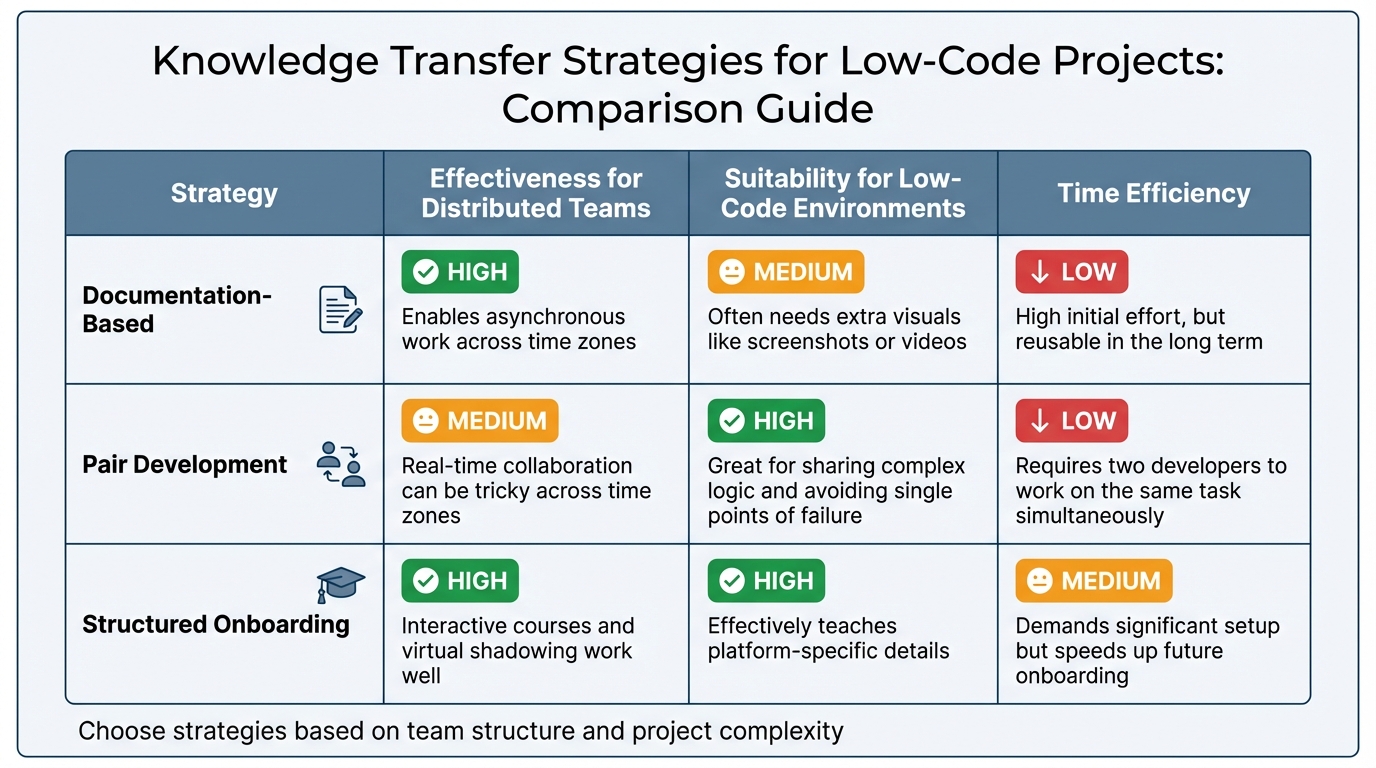
Knowledge Transfer Strategies for Low-Code Projects: Comparison Guide
Every knowledge transfer strategy comes with its own set of trade-offs. By understanding these nuances, teams can select the approach - or even a combination of approaches - that aligns best with their workflows, particularly in distributed environments.
Here’s a breakdown of how different methods perform, especially in low-code development platform setups:
Documentation-based transfer is a strong choice for asynchronous collaboration across time zones. While it demands considerable initial effort, including the addition of screenshots or video walkthroughs, it offers lasting reusability. However, a drawback is that employees often spend up to 30% of their time searching for the right information.
Pair development excels at transferring tacit knowledge and reducing the risk of single points of failure. That said, it can slow down initial delivery and pose challenges for real-time coordination in different time zones.
Structured onboarding programs are effective at minimizing business disruption, cutting the risk of major setbacks by 50%. They also address platform-specific quirks and standards well. For instance, one tech consultancy saw a 40% reduction in onboarding time by incorporating documentation contributions as a performance metric. The downside? It requires a significant upfront investment from mentors and senior developers to design and implement comprehensive training plans.
Here’s a quick comparison of these strategies:
| Strategy | Effectiveness for Distributed Teams | Suitability for Low-Code Environments | Time Efficiency |
|---|---|---|---|
| Documentation-Based | High: Enables asynchronous work across time zones. | Medium: Often needs extra visuals like screenshots or videos. | Low: High initial effort, but reusable in the long term. |
| Pair Development | Medium: Real-time collaboration can be tricky across time zones. | High: Great for sharing complex logic and avoiding single points of failure. | Low: Requires two developers to work on the same task simultaneously. |
| Structured Onboarding | High: Interactive courses and virtual shadowing work well. | High: Effectively teaches platform-specific details. | Medium: Demands a significant setup but speeds up future onboarding. |
This comparison highlights the strengths and trade-offs of each method, helping teams make informed decisions for efficient knowledge transfer in low-code environments.
Conclusion
Selecting the right knowledge transfer strategy for your low-code project hinges on what needs to be taught and how your team operates. While documentation is great for capturing explicit details like system architecture, it often misses the tacit knowledge that drives 60–80% of team value. On the other hand, pair development excels at transferring these nuanced insights, boosting skill retention by 2–4x, even though it may initially slow down delivery.
Structured onboarding offers a balanced solution by combining interactive learning with documentation. This method not only accelerates new hire productivity but also reduces the risk of business disruption caused by employee turnover by 50%. For growing teams, this approach can be especially effective.
The best results often come from blending multiple strategies. As Brad Schmitt explains:
"Knowledge transfer isn't a deliverable you hand off at the end. It's a capability your team builds while the work happens".
To enhance team self-sufficiency by 40–60%, consider starting paired work during weeks 2–4. Maintain decision logs to document reasoning and establish standard operating procedures to streamline cross-training.
For distributed teams, thorough documentation and recorded onboarding sessions are essential. Meanwhile, co-located teams can benefit from pair programming and in-person mentoring. While free low-code platforms can accelerate development, projects may be complex, as Brandon Wozniewicz points out, but this comprehensive approach ensures your team grows beyond just relying on documentation.
FAQs
Which knowledge transfer method should we start with?
Starting with a well-organized and easy-to-follow documentation process is a smart move. It lays the groundwork for team members and new hires to quickly grasp workflows, minimizing the risk of losing important knowledge and ensuring smooth operations. By creating thorough documentation and maintaining centralized knowledge repositories, critical information becomes readily available. This approach also helps break down knowledge silos, making it a practical first step for transferring knowledge in low-code projects.
What should low-code documentation include (beyond screenshots)?
Effective low-code documentation should do more than just include screenshots. It needs to cover the application's architecture, explain key design decisions, and outline workflows in detail. The inclusion of step-by-step instructions is crucial, along with troubleshooting tips and clear explanations of data sources, integrations, and dependencies.
To make the documentation genuinely useful, ensure it features up-to-date comments directly within the platform and follows a well-organized structure. This approach supports smooth onboarding, simplifies knowledge transfer, and aids ongoing maintenance. Ultimately, it ensures the documentation serves as a reliable and practical resource for both current and future developers.
How do we do pair development across time zones?
To effectively pair program across different time zones, prioritize clear communication and choose the right tools. Tools that allow shared control, like giving both participants access to the keyboard and mouse, are essential. Additionally, setting overlapping work hours ensures opportunities for real-time collaboration. Regular video calls, chat platforms, and daily stand-ups are also key to staying aligned. These practices make it easier to share knowledge and maintain productive teamwork, even with time zone challenges.