Free low-code platforms and proprietary solutions are changing how businesses handle compliance. By replacing manual coding with intuitive drag-and-drop tools, these platforms streamline workflows, reduce errors, and ensure adherence to complex regulations like GDPR, HIPAA, and AML. They integrate built-in safeguards such as Role-Based Access Control (RBAC), encryption, and automated audit logging, making compliance a seamless part of the development process.
Key benefits include:
- Faster updates: Compliance logic is separate from application code, enabling quick adjustments to regulatory changes.
- Pre-built templates: Industry-specific templates for standards like GDPR and SOC 2 save time and effort.
- Audit readiness: Automated logs and evidence collection simplify audits and reduce risks.
- Cost savings: Automation lowers compliance-related expenses and breach costs.
For example, a blockchain company partnered with a low-code platform to automate AML and KYC checks, onboarding 98% of customers in under 30 seconds while expanding to 34 countries. Similarly, a government agency integrated legacy systems to cut license processing times from 30 days to 3 days without compromising security.
Low-code platforms are transforming compliance, making it faster, more efficient, and less error-prone.
Perfect Form streamlines legal compliance with low-code
sbb-itb-33eb356
Common Compliance Challenges Businesses Face
Even with some companies allocating up to 10% of their revenue to regulatory compliance, many still encounter significant hurdles that increase their risk of violations and financial penalties.
Changing Regulations and Complex Requirements
Keeping up with regulatory updates can feel like aiming at a moving target. For example, 20% of UK businesses were unaware of their obligations under the newly introduced NIS2 framework. The challenge becomes even greater for companies operating globally. Regulations like GDPR in Europe, HIPAA in the U.S., DPDPA in India, and PIPL in China each come with distinct rules for data management and cross-border transfers. On top of that, emerging frameworks like ESG reporting requirements (CSRD and SFDR) add another layer of complexity.
Compliance teams often spend countless hours trying to align these updates with internal policies.
"2025 will be the Year of Regulatory Shift fueled by a new Administration, agency leadership changes, and expanded regulatory divergence" - Amy Matsuo, Regulatory Insights Leader at KPMG LLP
These constant changes only worsen the challenges of manual compliance processes.
Manual Workflows and Human Error
A significant 65% of compliance professionals still rely on manual processes. This reliance often leads to misplaced spreadsheets, version control issues, and errors in data entry. Employee turnover further complicates matters, as it can result in the loss of critical audit trails.
The financial repercussions are hard to ignore. In January 2026, FINRA fined three affiliated firms $1.1 million for supervisory failures tied to poor documentation and workflow issues. Similarly, a global bank faced an $80 million fine in 2020 after manual checks failed to detect security flaws in its risk management system. Addressing non-compliance issues after the fact can cost two to three times more than investing in proprietary low code platforms from the start.
Audit Preparation and Reporting Difficulties
Manual workflows also make audit preparation a time-consuming and stressful ordeal. Businesses often scramble to assemble evidence from various systems, diverting IT and security teams just as deadlines approach. Traditional audits typically review only a small fraction of records, leaving up to 99% of potential violations undetected.
The stakes are high. Companies with low compliance maturity can face data breach costs nearly $2 million higher than those with automated monitoring systems. Insurers are also raising the bar, with cyber insurance premiums increasing by over 20% year-over-year as of 2026, requiring proof of strong compliance measures.
"Manual processes, once the norm, are now seen as inefficient and error‑prone, often leading to audit fatigue and increased risk of non‑compliance" - Ethan Carter, cybersecurity expert
How Low Code Platforms Solve Compliance Problems
Low-code platforms address compliance challenges by eliminating technical hurdles that can slow down updates. Instead of waiting for custom code, these platforms allow compliance teams to use drag-and-drop tools to create workflows on their own, keeping compliance logic separate from core application code. This is crucial because regulations are always changing - teams can now update rules in hours or days instead of months.
The financial stakes are high. The average cost of a data breach globally is $4.88 million, but non-compliance adds an extra $174,000 to that figure. Companies using automated security measures report $1.9 million in savings on breach costs and can identify and contain incidents 80 days faster on average. These benefits form the backbone of the solutions outlined below.
Quick Implementation and Flexibility
Low-code platforms enable experts to quickly adapt workflows as regulations shift. For example, a government agency automated its business licensing process, which previously required manual coordination across eight outdated systems. By streamlining this workflow while meeting public sector security requirements, the agency slashed processing time from 30 days to just 3 days. This kind of agility reduces risks and lowers breach-related costs.
These platforms also come with built-in safeguards like Role-Based Access Control (RBAC), encryption, and audit trails, embedding compliance into the development process from the start. According to Gartner, 70% of new enterprise applications will be built in low-code environments by 2025, a dramatic increase from 25% in 2020.
Pre-Built Templates and Governance Tools
Low-code platforms provide industry-specific templates and governance tools that enforce compliance automatically. These ready-made frameworks eliminate the need to build compliance workflows from scratch. Templates are available for major standards like HIPAA, GDPR, SOC 2, ISO 27001, and the Digital Operational Resilience Act (DORA). Financial institutions, in particular, benefit from templates tailored for Anti-Money Laundering (AML) and Know Your Customer (KYC) processes, which align with FATF, FinCEN, and eIDAS 2.0 requirements.
"No-code orchestration is most effective when applied across the entire KYC lifecycle, rather than isolated onboarding steps." - Harry V, Chief Product Officer, ComplyCube
Governance tools help prevent mistakes. Policy-as-Code enforces strict data and jurisdiction rules. Data Loss Prevention (DLP) systems automatically stop sensitive data from being sent to unauthorized destinations. Real-time logging tracks every change and access event, often storing records in tamper-proof Write-Once-Read-Many (WORM) formats. However, despite these features, only 21% of organizations have formal policies for no-code development, while 75% of IT leaders remain concerned about security and governance.
Easy Integration with Existing Systems
Low-code platforms also simplify integration across diverse systems, which is critical since compliance data is rarely centralized. Using visual development tools and pre-built connectors, these platforms link different systems without requiring custom code. They even include adapters for older protocols and file formats, enabling modern workflows to connect with legacy systems that lack APIs.
Integration logic is centralized in a single cloud-managed platform, streamlining data flow across hybrid and multi-cloud setups. Automated data mapping tools align different system structures, creating a unified compliance management layer. Real-time webhook synchronization ensures constant compliance monitoring. By consolidating data, organizations gain real-time oversight of their compliance landscape. Additionally, low-code platforms can cut API integration costs by 50–70% compared to traditional methods. Today, nearly 28% of application portfolios are managed with low-code technologies, and this is projected to grow to nearly 40% by 2031.
Step-by-Step Guide to Automating Compliance with Low Code Platforms
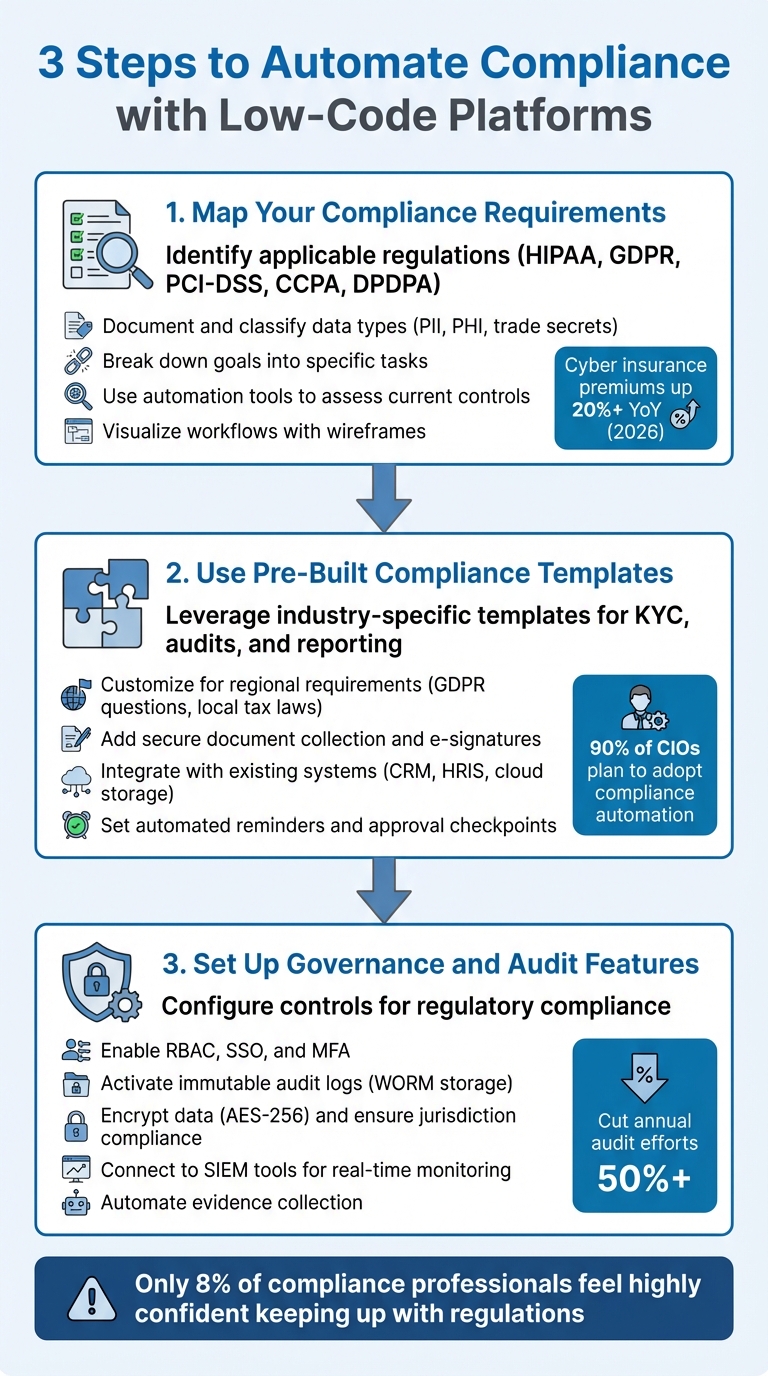
3-Step Process to Automate Compliance with Low-Code Platforms
Low-code platforms simplify compliance automation when approached methodically. The process begins with understanding your regulatory requirements and progresses through building workflows that enforce compliance seamlessly.
Step 1: Map Your Compliance Requirements
Start by identifying all the regulations that apply to your business. For healthcare, this could mean HIPAA compliance. Financial services must consider PCI-DSS, AML, and KYC, while global operations need to account for rules like GDPR (Europe), CCPA (California), or India's DPDPA.
Document these regulations, classify your data (e.g., PII, PHI, trade secrets), and link each type to its jurisdiction. This helps define where your data should reside and who can access it. Break down broad compliance goals into specific tasks. For instance, instead of saying "comply with GDPR", outline steps like "add consent screens for EU users" or "create workflows for 30-day data deletion."
Use automation tools to assess your current controls and align them with frameworks like ISO 27001 or SOC 2. This helps identify any gaps. Visualizing compliance processes with wireframes ensures your workflows meet regulatory requirements before implementation.
Cyber insurance premiums have surged over 20% year-over-year as of 2026. A clear compliance map can help avoid costly missteps.
Once you've mapped your requirements, the next step is to leverage pre-built templates for efficiency.
Step 2: Use Pre-Built Compliance Templates
With your compliance needs mapped, take advantage of pre-built templates tailored to tasks like KYC onboarding, audit preparation, or regulatory reporting. These templates save time by incorporating industry best practices and eliminating the need to design workflows from scratch.
Customize these templates to fit your specific needs. For example, include GDPR-related questions for European operations or adjust document requests to comply with local tax laws. Low-code platforms often allow you to add secure document collection, e-signatures, and automated file requests with simple drag-and-drop tools. Branching logic can adapt workflows based on factors like region, risk level, or jurisdiction-specific rules.
A regional accounting firm saw success using Moxo's templates with "magic links" for client document uploads, enabling external users to complete tasks without needing accounts.
Integrate these templates with your existing systems - like CRM, HRIS, or cloud storage - via APIs. This ensures workflows trigger automatically as statuses change. Add checkpoints for approvals and set milestones with automated reminders to keep processes on track. It’s no surprise that 90% of CIOs and Chief Compliance Officers plan to adopt automation in compliance efforts in the near future.
After streamlining with templates, the final step is to configure governance and audit features for comprehensive oversight.
Step 3: Set Up Governance and Audit Features
To meet regulatory standards, configure governance controls that demonstrate compliance to auditors and regulators. Start with Role-Based Access Control (RBAC) to restrict access based on user roles. Enhance security with Single Sign-On (SSO) and Multi-Factor Authentication (MFA) by following low-code security best practices.
Enable immutable audit logs to track every login, data access, configuration change, and publishing action. Use Write Once Read Many (WORM) storage and hash-chaining to create tamper-proof records. For example, financial services in the EU must comply with the Digital Operational Resilience Act (DORA), effective January 17, 2025.
Encrypt sensitive data with AES-256 for storage and HTTPS/TLS for transmission. For global operations, ensure data stays within specific jurisdictions, such as the EU, India, or Brazil, using residency-aware routing. Segregate environments (development, testing, production) to prevent unvetted applications from affecting live systems. Implement Data Loss Prevention (DLP) policies to control the flow of sensitive data and maintain a list of approved API connectors.
Connect platform logs to Security Information and Event Management (SIEM) tools like Splunk or Sentinel for real-time monitoring and compliance reporting. Automate evidence collection - capturing documents, logs, and screenshots during workflows - to simplify future audits.
"We've got built-in rules, based on regulations and Bizagi enforces those rules. So there's no discretion in our process." – Sameer Adams, Head of Development at Coronation Fund Managers
| Feature Category | Specific Governance Feature | Regulatory Alignment |
|---|---|---|
| Access Control | RBAC, SSO, MFA, Just-In-Time Elevation | SOC 2, HIPAA, GDPR |
| Data Integrity | AES-256 Encryption, BYOK, DLP | GDPR, PCI-DSS, HIPAA |
| Accountability | WORM Audit Logs, Hash-chaining | SOX, GDPR, DORA |
| Sovereignty | Residency-aware Routing, Local Tenants | PIPL (China), DPDPA (India) |
| Oversight | SIEM Integration, Real-time Dashboards | SOC 2, ISO 27001 |
Despite these tools, only 8% of risk and compliance professionals feel highly confident in their ability to keep up with evolving regulations. Compliance-related activities can cost U.S. firms up to 3.3% of their total wage bill. Automating governance can ease this burden, cutting annual audit efforts by over 50%.
Industry Examples of Low Code Platforms for Compliance
Low-code platforms are helping various industries tackle compliance challenges head-on, turning complex regulatory requirements into efficient, automated workflows. Here's how different sectors are leveraging this technology to improve processes and meet strict standards.
Finance: Risk Management and Reporting
In the financial world, staying ahead of regulations like Basel IV, PSD2, and AML is a constant challenge. Low-code platforms simplify this by automating processes such as Know Your Customer (KYC), identity verification, and suspicious activity reporting. This means financial institutions can adapt to evolving rules without extensive coding.
For instance, Iccrea, an Italian banking group, used Appian to build 13 compliance applications, slashing processing times by an impressive 75%. Similarly, the Business Development Bank of Canada (BDC) reduced the development time for critical compliance apps from 30 months to just 8 months with Mendix. Meanwhile, Pincvision, specializing in trade compliance, automated complex regulations using Progress Corticon, onboarding new clients 70% faster and driving 30% business growth.
"We have developed significant applications on OutSystems that helped digitalize end-to-end processes and that strengthened our control framework and data quality." – Marco Witteveen, COO, GarantiBank
Automation is proving transformative, with firms reporting up to a 73% reduction in compliance processing time. This is critical in an industry where regulatory paperwork demands an additional 51 million hours of compliance work annually.
The healthcare sector is also reaping the rewards of low-code automation, particularly in protecting sensitive data.
Healthcare: Meeting HIPAA Requirements
Healthcare providers face the dual challenge of safeguarding Protected Health Information (PHI) and ensuring authorized access. Low-code platforms address this by offering automated encryption (both at rest and in transit), Role-Based Access Control (RBAC), Single Sign-On (SSO), and Multi-Factor Authentication (MFA). These features ensure sensitive data remains secure while being accessible to the right personnel.
Low-code solutions also create tamper-evident audit trails, logging every modification and access event automatically. This eliminates the need for manual documentation and provides a clear, audit-ready record. Healthcare organizations can quickly develop workflows for patient consent, data access requests, and breach notifications - embedding HIPAA compliance into every process without starting from scratch.
Beyond healthcare, the manufacturing industry is using low-code platforms to modernize and automate its compliance efforts.
Manufacturing: Automating Audits
Manufacturers face a host of compliance requirements, from safety inspections to quality management and equipment tracking. Low-code platforms replace outdated tools like manual logs and Excel sheets with centralized systems that generate audit-ready documentation automatically.
For example, Kaneka Malaysia streamlined 55 manual processes into 13 digital systems, achieving up to 100% time savings. Similarly, PVH Europe, the parent company of Calvin Klein and Tommy Hilfiger, used low-code to extend their SAP system, automating global budget tracking and external employee management while improving data accuracy.
Mobile-friendly low-code apps enable safety officers to conduct on-site inspections, generate reports instantly, and assign corrective actions. One facility reported a 45% drop in safety incidents and a 35% improvement in compliance audit scores after implementing a low-code safety compliance system. When integrated with IoT devices, these platforms also monitor equipment performance in real time, enabling predictive maintenance and ensuring adherence to safety standards.
How to Select a Low Code Platform for Compliance
Choosing the right low-code platform is essential to meet regulatory requirements. A poor choice can lead to audit failures, security vulnerabilities, and expensive fixes.
Using the Low Code Platforms Directory
The Low Code Platforms Directory (https://lowcodeplatforms.org) is a helpful tool to find platforms tailored to your compliance needs. You can filter options by categories like Business Process Management (BPM) for features such as workflow automation and audit trails. For industry-specific needs, look for platforms with pre-built compliance frameworks, such as HIPAA for healthcare or financial regulations.
The directory also allows you to compare critical security features side by side. For example:
- Role-Based Access Control (RBAC) to manage permissions.
- Encryption standards like AES-256 to secure data.
- Single Sign-On (SSO) integration for streamlined authentication.
If data residency is a concern, prioritize platforms offering hybrid deployment options, which help ensure sensitive data stays within a private Virtual Private Cloud (VPC).
"Governance is what separates 'everyone can build apps' from 'everyone can build apps responsibly.'" – Team Kissflow
Once you've narrowed down your options, dive deeper into each platform's features to confirm they align with your compliance goals.
Must-Have Features for Compliance Platforms
To address risks like manual errors or audit failures, look for platforms with these key features:
- Granular Access Control: This ensures you can manage permissions at every level - pages, components, queries, and even individual data rows.
- Identity Integration: Supports SSO using standards like SAML 2.0, OIDC, and SCIM 2.0 for automated user management.
- Audit Trails: Automatically logs user activities, such as logins, data access, and permission updates. Ensure the platform retains logs for at least 90 days and allows SIEM export.
- Environment Management: Provides separate environments for development, staging, and production, with role-based deployment approvals to maintain oversight.
- Certifications and Legal Agreements: Look for platforms with certifications like SOC 2, GDPR, or HIPAA, and the ability to support agreements like BAAs.
- Pre-Built Compliance Templates: These templates simplify the creation of workflows for standards like HIPAA or GDPR, saving time and effort.
- Version Control Integration: Offers Git integration and automated testing to ensure compliance throughout the development lifecycle.
These features are critical for maintaining a secure and compliant development process while reducing manual workload and potential risks.
Conclusion
Low-code platforms simplify compliance, turning what was once a tedious, time-intensive process into something far more efficient. By automating tasks like data tracking and reporting, these tools not only save time but also minimize human error. Companies using advanced automation techniques see major improvements in identifying and containing breaches. In fact, proactive incident response plans can cut breach costs by 61%, saving an average of $2.66 million.
These platforms shine with their ability to adapt quickly to regulatory changes. Thanks to intuitive drag-and-drop interfaces, compliance teams can update workflows in days rather than waiting months for IT to rework systems. For instance, the Business Development Bank of Canada slashed development time for key applications from 30 months to just eight months, reducing the risk of falling behind on new compliance requirements.
Pre-built templates for standards like HIPAA, GDPR, and SOC 2 make it easier to stay on track, while automated audit trails ensure every change is documented and ready for review at a moment’s notice.
To make choosing the right platform easier, the Low Code Platforms Directory (https://lowcodeplatforms.org) offers filtering options tailored to security, deployment, and compliance needs. With 70% of new enterprise applications expected to rely on low-code or no-code technologies by 2025, it’s a great time to explore how these tools can enhance your compliance efforts and free up your team for more strategic work.
FAQs
Can low-code apps meet HIPAA, GDPR, and SOC 2 requirements?
Yes, low-code apps can align with HIPAA, GDPR, and SOC 2 requirements, but compliance isn't automatic - it depends on the platform's capabilities and how it's implemented. Features like encryption, access controls, and audit logs are crucial. That said, meeting these standards also requires developers and administrators to properly configure the platform, design with compliance in mind, and follow best practices to ensure regulatory guidelines are upheld.
How do low-code platforms prove compliance during an audit?
Low-code platforms make audits less daunting by providing tools like audit trails, version control, role-based access, user activity logs, and automated deployment pipelines. These features help organizations meet regulatory standards while ensuring processes remain transparent and accountable.
What should I check before choosing a low-code platform for compliance?
Before choosing a low-code platform, it's crucial to verify that it meets the governance and regulatory needs of your industry. Look for features like secure data storage, mechanisms to protect sensitive information, and tools designed to comply with standards such as HIPAA, PCI-DSS, or SOC 2. Also, ensure the platform enables you to set up guardrails, policies, and controls to stay aligned with industry regulations and reduce compliance risks.