Low-code platforms are transforming how teams work together by simplifying app development and reducing the gap between IT and business teams. Instead of comparing low-code vs traditional coding, these platforms use drag-and-drop tools, pre-built templates, and visual interfaces that allow both technical and non-technical users to collaborate effectively.
Key Takeaways:
- Faster Development: Low-code is 5-10x faster than traditional methods, completing projects in weeks instead of months.
- Bridging IT and Business: Citizen development empowers non-developers to build tools under IT supervision, cutting down miscommunication.
- Improved Communication: Shared visual tools eliminate the "language gap" between departments, reducing delays and rework.
- Cost Savings: Companies save on integration and development costs by using pre-built connectors and automating workflows.
Using Low-Code to Fuel Innovation & Collaboration
sbb-itb-33eb356
Common Problems in Cross-Team Collaboration
Even with advancements in digital tools, collaboration issues remain a massive drain on resources. In 2022, these breakdowns cost over $2.4 trillion and caused delays of six months or more for one-third of projects. The root of the problem often lies in the disconnect between business teams and IT departments. While business teams focus on goals and outcomes, IT teams prioritize technical constraints and coding. When these two groups fail to align, the result is confusion, inefficiency, and hefty costs. Miscommunication is often at the heart of these challenges.
Communication Barriers Between IT and Business Teams
One of the biggest hurdles is the "language gap" between business and IT. Business teams typically describe their needs in practical, outcome-focused terms - like requesting a dashboard to track customer engagement or an automated approval system. Meanwhile, IT teams need to translate these requests into technical deliverables, such as database structures or API calls. This translation process is rarely seamless.
Without a shared language or visual tools to clarify ideas, misunderstandings can pile up at every stage of the process. IT teams often lack insight into business roadmaps, while business teams may not have access to IT's planning tools. This disconnect leads to competing priorities, duplicated work, and a loss of trust between departments.
The numbers tell a clear story: 73% of managers outside IT want more business technologists to help bridge this gap. Yet, only 43% of IT professionals in large companies believe agile principles are being applied effectively. When communication breaks down, business teams sometimes take matters into their own hands, creating unsanctioned "shadow IT" solutions. While these quick fixes might solve immediate problems, they often introduce security risks and add to technical debt.
Bottlenecks in Standard Development Workflows
Traditional development workflows bring their own set of challenges. IT teams are often stretched thin, juggling tasks like infrastructure upgrades, cloud migrations, and security compliance. As a result, smaller projects - like internal dashboards or automated workflows - are frequently pushed to the back burner during development sprints.
These workflows are also plagued by slow feedback loops, often taking weeks or even months to deliver a working model. By the time the product is ready, misaligned expectations can lead to costly rework. Additionally, while individual departments may adopt tools to improve their own efficiency, these isolated solutions can fragment the organization. For instance, marketing, sales, and operations might each rely on different systems - or even basic spreadsheets - trapping information in silos and preventing a unified view of the business.
These challenges highlight the urgency for tools that can bridge the gap between business and IT. A low-code development platform offers a way to address these issues, providing a shared framework for collaboration and faster project delivery.
How Low Code Improves Team Collaboration
Low-code platforms address common collaboration challenges by breaking down the "translation gap" between IT and business teams. Instead of relying on technical specifications, these platforms allow everyone to work together in a shared visual environment, focusing on tangible outcomes. Johan den Haan, CTO of Mendix, captures this idea perfectly:
"A visual language is the clearest, most unambiguous way to transfer knowledge and ideas between business domain experts and developers".
This approach isn't just theoretical - it delivers real results. In October 2025, Guillaume Delafosse, an architecture manager at CBTW, shared how a customer portal project was completed in just four months instead of the estimated twelve. The key? Business users directly shaped the portal’s functionality within the platform, reducing their reliance on IT. Similarly, a retail company using OutSystems enabled its marketing team to visually map out customer journeys while developers simultaneously handled backend integration. This eliminated the usual back-and-forth between teams.
These platforms foster collaboration through visual tools and real-time features that help break down departmental silos.
Visual Tools That Improve Communication
Drag-and-drop interfaces and visual process designers create a shared language, removing the need for technical jargon. These visual models go beyond being simple mockups - they form the actual application logic. For instance, when an analyst designs an approval workflow using visual blocks, that diagram becomes executable code. This eliminates the risk of losing or misinterpreting requirements during translation. By 2026, advancements in natural language processing are expected to allow platforms to generate application prototypes directly from plain-text descriptions, making it even easier for business users to communicate their ideas to IT.
Real-Time Collaboration Features
Features like in-app commenting, instant updates, and feedback tools (e.g., Mendix App Insights) allow teams to work together seamlessly and iterate in real time. Centralized version control ensures that all contributions are merged into a single source of truth. For example, if a team provides feedback on a dashboard prototype, everyone sees the updates instantly, keeping communication smooth and efficient. Many platforms also integrate with tools like Slack, Microsoft Teams, and Jira, enabling teams to stick with their preferred workflows. Agile project management features, such as Kanban boards and Epics, further streamline processes by helping teams manage backlogs, assign tasks, and track progress in real time. This reduces feedback delays and minimizes costly rework cycles.
Improving Workflows with Low Code Integration
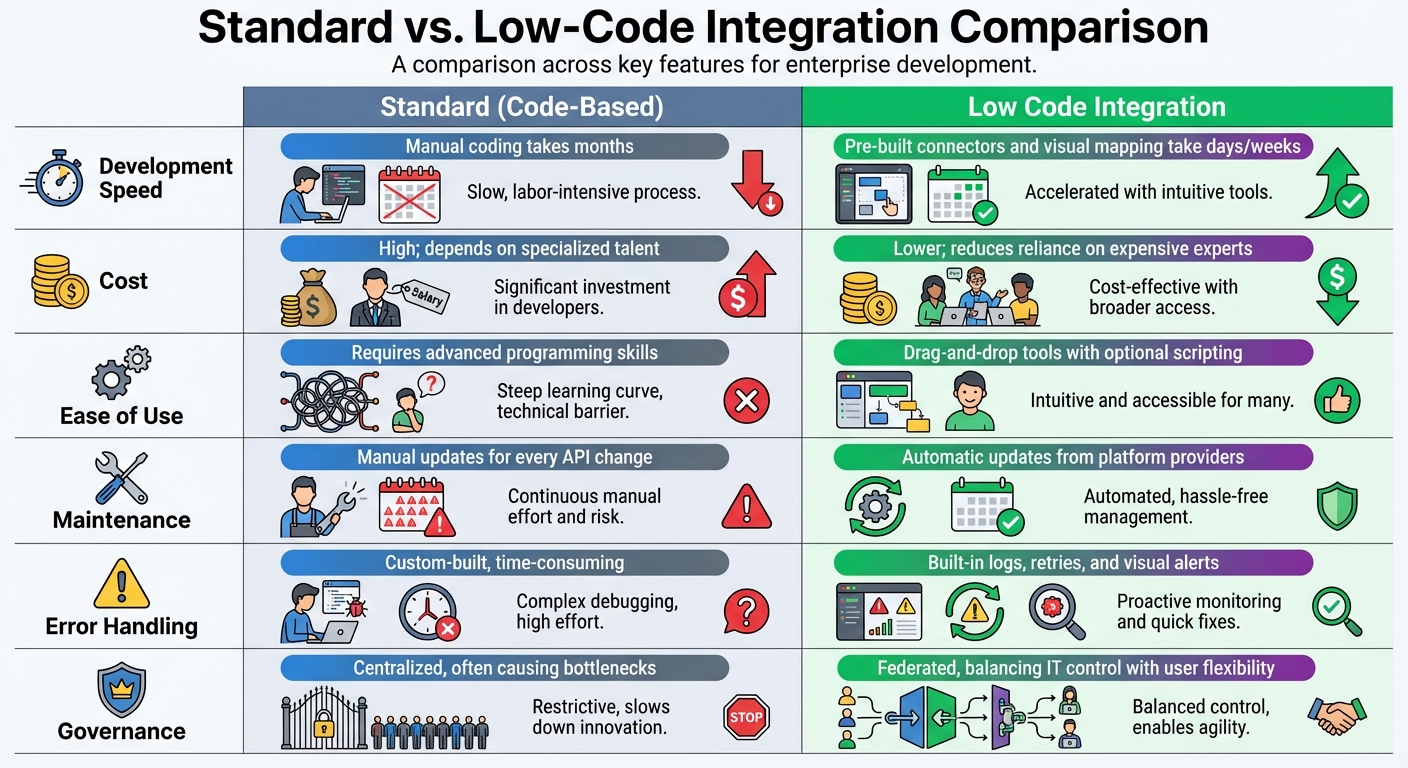
Standard vs Low-Code Integration: Speed, Cost, and Maintenance Comparison
Breaking down departmental silos and improving collaboration often hinges on effective system integration. But here's the catch: traditional integration methods are a headache. They require engineers to manually code API connections, manage error handling, and constantly update integrations as systems evolve. Low-code platforms offer a fresh approach by acting as an orchestration layer that connects disparate systems - like CRMs, ERPs, and billing tools - without piling on complexity. Instead of relying on fragile, direct integrations, these platforms create a centralized hub where data flows smoothly across teams. This setup not only simplifies connections but also speeds up project delivery.
With proprietary low-code connectors for enterprise software like SAP and Salesforce, low-code platforms eliminate the need for months of custom coding. And when pre-built options don’t quite fit the bill, these platforms support REST, GraphQL, and OpenAPI integrations, along with custom code extensions for those tricky edge cases. Essentially, 90% of the work can be done visually, leaving only 10% for scripting in languages like JavaScript or Python.
"Low-code excels at orchestrating connections between disparate systems... it is the integration layer between systems" - Dan O'Keefe, Appian.
Adopting cross-system orchestration can significantly cut costs, reducing integration maintenance expenses by 35% compared to traditional methods. Take Lufthansa, for example. In 2025, they used the Getint platform to sync workflows between Jira Data Center and Azure DevOps across 50+ projects. This on-premise solution met strict security standards while enabling real-time collaboration between development and operations. Similarly, Raiffeisen Landesbank built a secure bridge between their private Jira Data Center and Jira Cloud, allowing internal teams and external contractors to share ITSM workflows - like incidents and custom fields - while adhering to banking regulations.
Standard vs. Low Code Integration Comparison
| Feature | Standard (Code-Based) | Low Code Integration |
|---|---|---|
| Development Speed | Manual coding takes months | Pre-built connectors and visual mapping take days/weeks |
| Cost | High; depends on specialized talent | Lower; reduces reliance on expensive experts |
| Ease of Use | Requires advanced programming skills | Drag-and-drop tools with optional scripting |
| Maintenance | Manual updates for every API change | Automatic updates from platform providers |
| Error Handling | Custom-built, time-consuming | Built-in logs, retries, and visual alerts |
| Governance | Centralized, often causing bottlenecks | Federated, balancing IT control with user flexibility |
This comparison highlights the importance of a governance model that ensures security while enabling rapid innovation. Federated governance strikes this balance beautifully. IT departments set the guardrails - like security protocols and approval workflows - while business users build automations within those boundaries. This approach also helps curb "shadow IT", where teams resort to unsanctioned tools because IT solutions take too long. With low-code platforms providing a secure and approved environment, teams can move quickly without compromising on compliance.
Building Centers of Excellence for Low Code Collaboration
Establishing a Center of Excellence (CoE) creates a framework for sustainable and scalable low-code collaboration. Acting as an internal support hub, a CoE brings together people, processes, and tools under a shared vision. This setup encourages ongoing improvement and knowledge sharing, ensuring smooth cooperation between technical and business teams.
"A Low-Code Center of Excellence underscores the evolving nature of low-code development. It's not about achieving a static state of perfection." - Simone Mink, Mendix
A successful CoE revolves around the "5 P's": Portfolio, People, Process, Platform, and Promotion. Here's how they break down:
- Portfolio: Identify and prioritize the right projects.
- People: Define roles and provide training to build expertise.
- Process: Set governance rules and establish clear methodologies.
- Platform: Choose the right technology stack to support initiatives.
- Promotion: Share successes across the organization to build momentum.
Organizations typically start with a small setup team and gradually evolve into a structured model led by a Program Owner. Over time, these processes become integrated across the organization, often incorporating practices like low-code QA automation tools to streamline workflows.
One of the key advantages of a CoE is the formation of fusion teams - groups that combine IT specialists with business domain experts. These teams create a shared language for development, bridging gaps between technical and business needs. For instance, a global consumer goods company reported cutting workflow development costs by over 70% and reducing delivery times by 50% by leveraging agile practices and reusable components.
Governance: The Backbone of a CoE
Effective governance is essential for a CoE to thrive. IT teams should establish security and architectural guardrails that empower business users to innovate without compromising safety or efficiency. A lightweight, exceptions-based governance approach works well, with a structured intake process to prioritize projects based on factors like process maturity, integration complexity, and business value. This ensures the CoE focuses on high-impact initiatives while avoiding low-value distractions. Selecting the right platform also becomes part of this governance strategy, supporting long-term success.
Using the Low Code Platforms Directory
Choosing the right low-code platform is a critical step in building a strong CoE. The Low Code Platforms Directory offers a detailed filtering system to help organizations evaluate tools based on features like real-time collaboration, built-in integration options, and governance capabilities. For example, platforms that support shared data environments (like Microsoft Dataverse) can create a consistent foundation for business and analytics applications.
Conclusion
Low-code platforms are reshaping how teams work together by addressing communication gaps and workflow challenges. These tools replace complex coding with user-friendly visual interfaces and no-code/low-code resources, creating a shared language that bridges the divide between business and IT teams.
The impact is evident in real-world examples. First Philippine Holdings, for instance, automated over 100 office processes and digitized more than 1,000 workflows monthly, benefiting over 10,000 employees. iHeartMedia streamlined operations across marketing, sales, and publishing teams, enabling them to manage thousands of podcasts and support 456 million monthly downloads. Meanwhile, a US-based energy company achieved a 10x ROI by empowering employees to build their own solutions, automating more than 450 processes for 10,000 users.
"The organizations seeing the greatest ROI from low-code are not those that replaced their development teams, they're the ones that used low-code to amplify what their teams could deliver." - ToolJet Platform Evaluation Guide
To get started, selecting the right platform is crucial. Every organization has unique needs, whether it’s AI-assisted development, integration capabilities, or governance features. The Low Code Platforms Directory offers a powerful filtering system to help organizations find platforms tailored to their specific requirements, including collaboration tools, deployment options, and security features.
Identify high-impact use cases, like approval workflows or dashboards, and establish governance early to clarify what business users can create versus what requires IT involvement. With the right platform and framework, teams can move from idea to implementation in days instead of months. Low-code tools don’t just speed up processes - they transform how teams collaborate and innovate.
FAQs
What projects are best for low-code first?
Low-code works well for projects that demand speedy prototyping, regular updates, and close collaboration between business and technical teams. Think of internal dashboards, process automation tools, or apps that need input from multiple departments. These types of projects thrive on low-code’s visual development tools, the ability to adjust quickly, and its inclusivity for non-technical contributors. By shortening development cycles and encouraging active participation, low-code helps close the gap between business and IT, making workflows smoother and more efficient.
How do we prevent shadow IT with low-code?
Low-code platforms play a key role in minimizing the risks associated with shadow IT by providing controlled environments that prioritize security, compliance, and oversight. These platforms allow IT teams to establish permissions, track usage, and enforce policies, which helps mitigate threats like data breaches.
What makes low-code solutions even more effective is their ability to bridge the gap between IT and business teams. By encouraging collaboration, they meet the demand for faster development while ensuring everything stays within organizational rules. This means teams can innovate confidently and responsibly without compromising on governance.
What should a low-code Center of Excellence include?
A low-code Center of Excellence (CoE) brings together people, processes, and tools to align with an organization’s goals. Its foundation includes governance frameworks to oversee development, clearly defined roles for both technical and non-technical contributors, and structured processes for tasks like design, prototyping, and gathering feedback. Encouraging collaboration between business and IT teams is crucial - it drives efficient app development, secures stakeholder support, and ensures workflows stay smooth while maintaining high standards and fostering new ideas.