Hybrid deployment with low-code platforms combines cloud-based management with customer-controlled infrastructure, offering speed, flexibility, and compliance. This approach is ideal for businesses needing to build applications in the cloud while keeping sensitive data secure and within regulatory boundaries. Key use cases include:
- Modernizing Legacy Systems: Transition outdated systems without disrupting operations. Examples include federal agencies and enterprises upgrading their tools using free low code platforms while maintaining functionality.
- Cross-Departmental Workflow Applications: Connect data across departments while respecting data sovereignty rules, boosting efficiency and collaboration.
- Development and Testing Environments: Safely experiment with new features in the cloud while integrating with on-premises systems for production.
- Enterprise Compliance and Data Governance: Meet strict regulations by keeping sensitive data on-premises while leveraging cloud tools for orchestration.
- Internal Tools and Process Automation: Build tools that automate workflows across environments, reducing manual effort and improving data management.
Benefits include faster launches, reduced costs, and enhanced compliance. Challenges involve integration complexity, governance issues, and scalability limitations. To succeed, businesses should choose platforms that separate the control plane (cloud) from the data plane (on-premises) and start with pilot projects to test connectivity and security.
Use Cases of Hybrid Deployment
Modernizing Legacy Systems
Hybrid architecture offers a practical way to update outdated systems while keeping operations running smoothly. For example, in August 2022, a federal pretrial agency transitioned its 20-application SMART system from on-premises .Net/Oracle to the Microsoft Power Platform. Simple Technology Solutions (STS) spearheaded this effort, starting with the "AutoScreener" application. Using PowerApps and PowerAutomate, they introduced AI-driven risk assessments for offenders and mobile access for supervisors. This approach ensured the agency could continue functioning without interruption while improving its tools.
"By using Microsoft Power Platform, the STS team has implemented a low-code solution... which dramatically reduces time-to-market and increases the amount of flexibility, reusability, and scalability." - Simple Technology Solutions
Similarly, Limelyte revamped its 20-year-old "Extranet" ERP system. Over six months, they developed a new backend and Flutter-based mobile apps that worked alongside the legacy PHP system, all sharing a PostgreSQL database. This method ensured zero downtime and preserved 100% of financial data spanning two decades. In another case, a federal health agency collaborated with Guidehouse to modernize financial systems using a low-code platform on AWS Government Cloud. This solution addressed 80% of the agency's processes and went live in just eight months. The results? A 30% reduction in operations and maintenance costs and 23,000 labor hours saved annually.
These examples highlight how hybrid models can modernize systems without disrupting essential services.
Cross-Departmental Workflow Applications
Hybrid deployment is an excellent way to unify data across departments while adhering to data sovereignty rules. The global market for low-code enterprise workflow automation is expected to grow from $23.77 billion in 2025 to $37.85 billion by 2030, with a 9.52% annual growth rate. This surge reflects how businesses are using low-code platforms to connect ERP, CRM, and legacy systems into cohesive workflows.
Key elements of these implementations include Role-Based Access Control (RBAC) and centralized security that spans both cloud and on-premises systems. Visual orchestration tools further simplify collaboration between technical teams and business stakeholders, enabling quicker iterations on cross-departmental processes without requiring extensive coding knowledge.
Development and Testing Environments
Hybrid setups are ideal for development and testing. Teams can use public clouds to experiment with new features while relying on private infrastructure for integration with production systems. This separation allows developers to test freely without exposing sensitive production data or disrupting core operations.
By keeping the legacy system active during feature migrations, organizations have a safety net to roll back changes if needed. This method also allows teams to validate new features with real production data before full deployment. For instance, this strategy has helped organizations fix over 20,000 vulnerabilities and save 15,000+ man-hours in large-scale environments.
This controlled setup supports compliance efforts and ensures data governance remains intact.
Enterprise Compliance and Data Governance
Hybrid models are particularly effective for organizations with strict compliance needs. A European cybersecurity consultancy used SmartSuite to meet data residency requirements for banking and government clients. By keeping sensitive data on-premises or in private clouds while using public clouds for less sensitive tasks, the consultancy maintained regulatory compliance without sacrificing efficiency.
Industries like healthcare and finance, which face stringent regulations, benefit greatly from hybrid deployments. These setups allow sensitive data to remain within specific boundaries while leveraging cloud-based tools for orchestration, monitoring, and updates. Modern platforms offer enterprise-grade security features, such as AES-256 encryption and compliance with standards like SOC 2, GDPR, HIPAA, and CCPA. This approach not only meets regulatory demands but also reduces cyberattack risks by using outbound-only designs.
Internal Tools and Process Automation
Hybrid low-code platforms are increasingly being used to create internal tools that automate workflows across different environments. These tools often start with low-risk tasks like lead enrichment or support triage. By 2026, it's projected that 40% of enterprise applications will include AI agents, a sharp rise from less than 5% in 2024. This reflects the growing adoption of AI-powered automation.
Businesses can deploy such tools on-premises for processing sensitive data, in private clouds for operational purposes, or in public clouds for analytics. This flexibility eliminates the need to rewrite codebases and allows deployment times to be measured in hours rather than weeks. Hybrid platforms are particularly effective for automating repetitive tasks across departments while maintaining control over sensitive information.
This seamless integration of automation into broader workflows demonstrates the adaptability and efficiency of hybrid deployments.
sbb-itb-33eb356
Build and deploy AI apps faster with low code and DevOps | BRK125
Benefits and Challenges of Hybrid Deployment
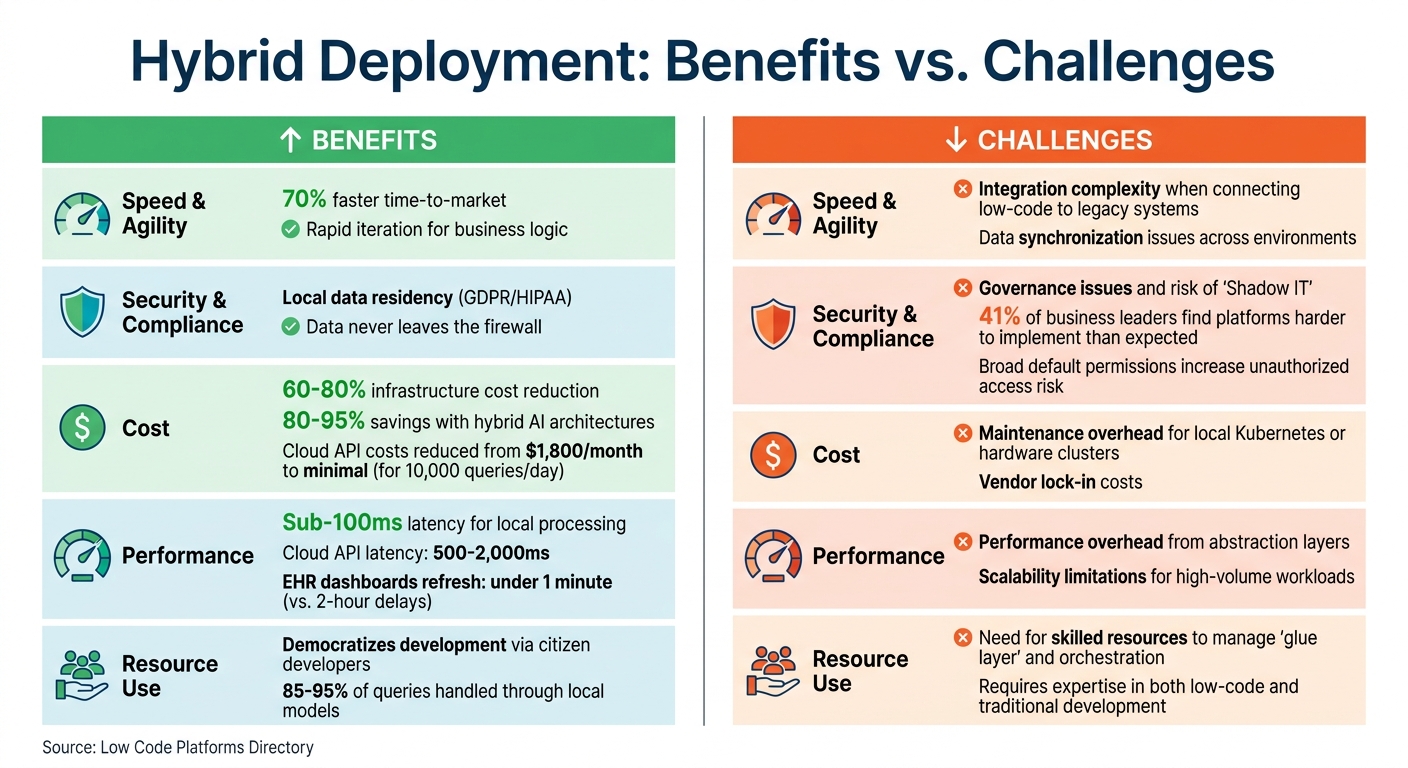
Hybrid Deployment Benefits vs Challenges Comparison
Benefits of Hybrid Deployment
Hybrid deployment can speed up the launch of business applications by as much as 70%, thanks to citizen developers who quickly build internal tools while professional developers focus on more intricate tasks.
Transitioning legacy systems to hybrid setups can lead to 60–80% savings in infrastructure costs. Additionally, hybrid AI architectures can reduce expenses by 80–95% compared to fully cloud-based solutions by handling most queries locally. For instance, routing 85–95% of queries through local models can slash monthly cloud API costs from $1,800 to a fraction of that for 10,000 queries per day.
This approach also supports compliance with regulations like GDPR, HIPAA, and DORA by keeping sensitive data on-premises while relying on cloud-based tools for orchestration. Using outbound-only connectivity enhances security by preventing unsolicited external access, which reduces the attack surface. Furthermore, local AI models provide lightning-fast response times - under 100 milliseconds - compared to the 500–2,000 milliseconds typical of cloud APIs. In healthcare, hybrid integrations can drastically improve efficiency, such as enabling EHR dashboards to refresh in under 1 minute, compared to the 2-hour delays caused by older systems.
Despite these advantages, hybrid deployments are not without their hurdles.
Challenges of Hybrid Deployment
While hybrid deployments offer numerous benefits, they also come with challenges related to integration, governance, and scalability.
One major issue is integration complexity. Many legacy systems lack modern APIs, requiring middleware or API wrappers to connect with low-code tools. These intermediary layers can be difficult to maintain and may introduce points of failure. Additionally, workflows spanning both cloud and on-premises environments can lead to data synchronization problems.
Governance is another concern. Decentralized app creation without proper oversight can result in "application sprawl", inconsistent data definitions, and the risks associated with shadow IT. A survey found that 41% of business leaders consider low-code platforms more challenging to implement and maintain than they initially anticipated. Vendor lock-in is also a potential problem, as proprietary frameworks and data structures can make switching platforms costly and complicated.
Scalability can also be limited. Abstraction layers in low-code platforms may hinder performance optimization for workloads with high volumes. Moreover, hybrid architectures require skilled professionals who can navigate both low-code platforms and traditional development to manage backend complexities. Security configurations demand careful attention as well, since low-code environments often come with broad default permissions, increasing the risk of unauthorized access.
Comparison Table: Benefits vs. Challenges
| Category | Benefits | Challenges |
|---|---|---|
| Speed & Agility | 70% faster time-to-market; rapid iteration for business logic | Integration complexity when connecting low-code to legacy systems |
| Security & Compliance | Local data residency (GDPR/HIPAA); data never leaves the firewall | Governance issues; risk of "Shadow IT" without strict IT oversight |
| Cost | 60–80% infrastructure cost reduction; lower cloud egress fees | Maintenance overhead for local Kubernetes or hardware clusters |
| Performance | Sub‑100 ms latency for local processing; avoids cloud API outages | Performance overhead from abstraction layers in low-code platforms |
| Resource Use | Democratizes development via citizen developers | Need for skilled resources to manage the "glue layer" and orchestration |
How to Choose the Right Low Code Platform for Hybrid Deployment
Using the Low Code Platforms Directory
When it comes to hybrid deployment, choosing the right low-code platform can make all the difference. The Low Code Platforms Directory (https://lowcodeplatforms.org) is a great place to start. It offers a filtering system to help you identify platforms tailored to your specific hybrid deployment needs. Start by listing all your compliance requirements - such as HIPAA, GDPR, or PCI - to streamline your search.
Focus on features like "hybrid deployment support", "AI/Automation tools", and "compliance capabilities." The goal is to find platforms that separate the cloud-based control plane (used for orchestration and monitoring) from the customer-controlled data plane (where sensitive data resides). This separation is crucial for secure and efficient hybrid deployments.
Features to Look For
A key feature to prioritize is the separation of the control plane (cloud orchestration) from the data plane (on-premises, VPC, or edge environments). Additionally, ensure the platform offers secure external storage for credentials, keeping sensitive keys out of both deployment planes.
Unified orchestration is another must-have. Look for platforms that provide a single dashboard to manage configurations across multiple regions and environments, eliminating the need for manual adjustments. It's also worth checking if the platform supports a variety of protocols beyond REST APIs, such as WebSockets, message queues, or long-running sagas for handling complex backend processes.
Governance tools are equally important. Features like centralized logging, version control, rollback options, and automated audit trails ensure you maintain full control and visibility over your deployments. If you're planning to incorporate AI-driven workflows, confirm that the platform supports large language model (LLM) orchestration, context management, and fallback mechanisms for autonomous operations. Once these essentials are in place, evaluate the platform's scalability and support.
Evaluating Platform Scalability and Support
Start with a pilot project to test the platform's hybrid connectivity and security on a low-risk internal application before scaling to critical systems. Platforms like Alpha Anywhere and Qodly provide free trials, allowing you to explore features like outbound-only networking and secure secrets management.
It's also wise to have an exit strategy. Choose platforms with open APIs and exportable code to avoid being locked into proprietary frameworks that could make switching costly. Use tools like k6 or Locust to simulate real-world traffic and assess performance, as low-code abstraction layers can sometimes introduce latency at scale.
"The real test isn't theoretical. Healthcare systems need HIPAA-safe analytics without losing elasticity. Banks require cross-border data residency while maintaining millisecond fraud detection." – Jim Kutz, Airbyte
Finally, examine the vendor's ecosystem and support resources. Comprehensive documentation, active community forums, and a clear development roadmap are good indicators that the platform can adapt to your evolving needs. Check for integrations with major cloud providers like AWS, Azure, and Google Cloud, as well as support for CI/CD pipelines to streamline testing and deployment. If your applications demand high concurrency or low latency, prioritize platforms that focus on backend orchestration and real-time decision-making rather than just UI design.
Conclusion
Hybrid deployment merges the speed and ease of low-code platforms with the control and performance of custom infrastructure. As highlighted in this article, businesses across various industries are leveraging this model to modernize outdated systems, streamline internal processes, ensure compliance, and manage costs effectively.
The real key to success? Knowing when to use what. As Rickapi aptly stated:
"The real skill isn't knowing how to build custom software. It isn't knowing how to use low-code platforms. It's knowing which to use when".
Low-code tools shine when you need rapid iterations and visual workflows that empower non-technical teams. On the other hand, custom development is best reserved for handling complex data models, meeting high-performance demands, or creating unique competitive advantages.
Real-world examples underscore the value of hybrid deployment. For instance, RedZone achieved a 40% reduction in work order processing time and boosted data accuracy by 80% with a hybrid FlutterFlow app built for offline field operations. Similarly, Lamoda automated HR workflows for 13,000 employees using Directual, replacing error-prone email processes and creating an in-house "app factory".
If you're exploring hybrid architecture, the Low Code Platforms Directory can help you find platforms that separate cloud-based orchestration from customer-controlled data planes while meeting regulatory requirements. Start small with a pilot project to test connectivity and security. Clearly document compliance needs, define boundaries between low-code and custom components, and ensure your "glue layer" maintains a single source of truth for data. With the right strategy, hybrid deployment offers the flexibility of the cloud without sacrificing control - delivering the best of both worlds.
FAQs
What should stay on-premises vs in the cloud?
Sensitive or regulated data is best kept on-premises to ensure compliance, maintain control, and safeguard security. On the other hand, tasks that are less sensitive and demand scalability are ideal candidates for the cloud. This hybrid approach balances data protection with operational effectiveness.
How can low-code apps connect to legacy systems without APIs?
Connecting low-code apps to legacy systems that lack APIs is achievable with the help of specialized tools. For instance, RPA connectors can facilitate data exchange with legacy systems like IBM AS400. Additionally, middleware or integration platforms designed to handle legacy protocols and data formats can act as a bridge, enabling modern low-code platforms to communicate effectively with older infrastructure. These solutions ensure seamless integration without requiring extensive modifications to the legacy systems.
Which security and compliance features matter most in hybrid?
Hybrid deployments come with a range of features designed to address security and compliance needs. Some of the most critical ones include:
- Local Data Processing: This enables organizations to meet strict regulations like HIPAA and GDPR by ensuring sensitive data is processed and stored locally, reducing the risk of non-compliance.
- Data Residency and Sovereignty Control: Businesses retain control over where their data is stored, ensuring it remains within specific geographic boundaries as required by various regulations.
- Customer-Managed Infrastructure: By allowing customers to manage their own infrastructure, hybrid deployments provide an additional layer of security, giving organizations more control over their systems and data.
These features work together to ensure compliance with regulatory requirements while maintaining strong security measures in hybrid environments.