Low-code data mapping tools simplify connecting data sources to target systems using visual interfaces. These platforms reduce reliance on manual coding, saving time and resources. This guide evaluates five popular tools - Integrate.io, Talend, Informatica, Boomi, and SnapLogic - based on key criteria:
- Ease of use: How intuitive is the interface for non-technical users?
- Connector library: Number of pre-built integrations available.
- Data transformation: Capabilities for cleaning, enriching, and automating schema detection.
- Scalability: Ability to handle large data volumes and real-time flows.
- Deployment options: Cloud, on-premises, or hybrid compatibility.
- Security: Compliance with SOC 2, HIPAA, GDPR, and more.
- Pricing: Subscription or usage-based models.
Quick Comparison
| Tool | Strengths | Limitations | Pricing | Best For |
|---|---|---|---|---|
| Integrate.io | No-code UI, fixed-fee pricing, 220+ connectors | Limited error logs, cluttered for complex tasks | $1,200+/month | Mid-market companies, compliance |
| Talend | 1,000+ connectors, open-source option | Steep learning curve, complex UI | Starts at $1,000/year | Enterprise, Big Data processing |
| Informatica | AI automation, scalable, metadata management | High cost, requires training | Usage-based (IPUs) | Large enterprises, regulated sectors |
| Boomi | Fast deployment, strong API management | High cost for SMBs, limited transformation granularity | $99+/month | Hybrid setups, ERP-CRM workflows |
| SnapLogic | AI-driven mapping, real-time streaming | Performance issues with large data volumes | Subscription-based | AI-enhanced, real-time processing |
Each tool has unique strengths depending on your data needs, budget, and technical expertise. For example, Integrate.io offers simplicity and fixed pricing, while Informatica caters to complex, large-scale operations. Testing tools with sample data before committing is crucial for the best results.
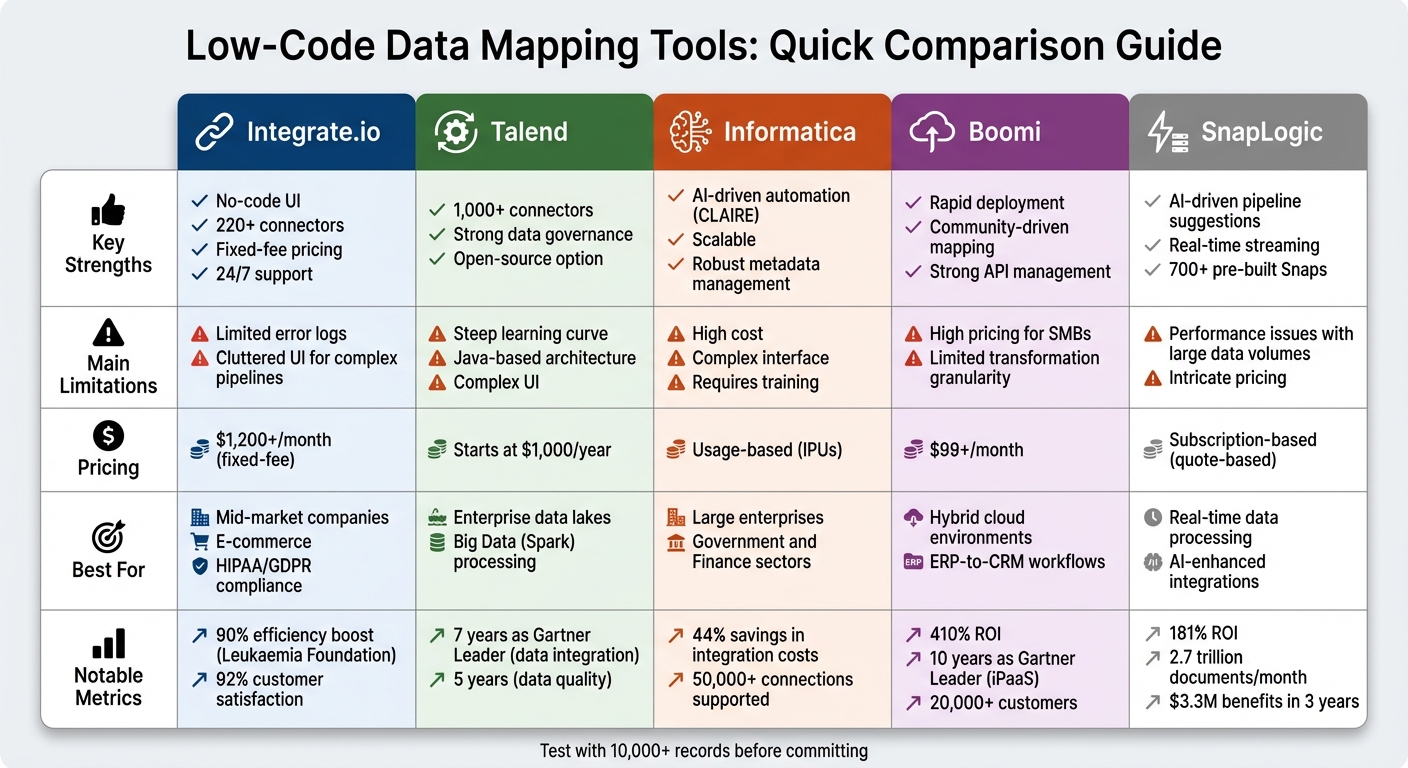
Low-Code Data Mapping Tools Comparison: Features, Pricing, and Best Use Cases
Analytics in 15: No-code/Low-code ETL and Data Integration with AWS
sbb-itb-33eb356
1. Integrate.io
Integrate.io is a no-code/low-code platform designed to simplify and speed up data integration processes. With its visual data mapping tools, users can bypass manual coding. The platform offers over 220 pre-built connectors, covering a wide range of integration needs.
Data Mapping Features
Integrate.io provides more than 200 transformation functions to clean, normalize, and modify data. It also automates schema detection, making it easier to manage complex nested JSON objects by flattening or restructuring them. The platform supports Change Data Capture (CDC) methods, including log-based, timestamp-based, and trigger-based approaches, to track database changes. Observability tools proactively alert teams to potential issues like schema drift and null spikes, helping them address problems early.
For example, the Leukaemia Foundation of Australia reported cutting pipeline setup time from two weeks to just 30 minutes after adopting Integrate.io. This led to a 90% boost in operational efficiency and enabled real-time analytics in Snowflake.
These mapping features create a solid foundation for smooth low-code CRM integrations, which are explored further below.
Integration Capabilities
Beyond its extensive library of native connectors, Integrate.io supports custom integrations through REST API and HTTP connectors. The platform accommodates various data movement patterns, including ETL, ELT, CDC, and Reverse ETL. By performing transformations directly within pipelines, it reduces the computational load on data warehouses, saving on costs.
Security and Compliance
Integrate.io adheres to strict compliance standards, including SOC 2, HIPAA, GDPR, and CCPA. Data is encrypted both in transit and at rest, while role-based access control (RBAC) ensures that only authorized users can access sensitive information. Audit logs provide visibility into data lineage and integration health, and the platform operates within Amazon's secure data centers. Security features, such as mid-pipeline data masking, are built directly into its low-code workflows.
Scalability
Thanks to its cloud-native architecture, Integrate.io scales effortlessly to meet enterprise demands. It supports high-volume batch processing and real-time data flows, maintaining performance even as data volumes grow. Global data center coverage ensures high availability and reliability.
Pricing Models
Integrate.io offers a fixed-fee pricing structure starting at $1,200 per month, allowing unlimited usage without the unpredictability of compute-based billing. Users can test the platform with a 14-day free trial for ETL, ELT, and CDC solutions. With a 92% customer satisfaction score, the platform is also known for its quick support response times - averaging 2 minutes for first contact and 51 minutes for issue resolution.
2. Talend
Talend delivers a comprehensive integration platform that handles mapping, data quality, and governance across cloud, hybrid, and on-premises environments. Following its acquisition by Qlik in May 2023, Talend has expanded its capabilities. With over 1,000 pre-built connectors and native support for big data frameworks like Hadoop and Spark, it’s designed to meet the demands of enterprise-scale operations.
Data Mapping Features
Talend combines a user-friendly drag-and-drop interface with powerful technical features. Its Dynamic Schema Columns automatically infer data formats at runtime, making it easier to manage diverse datasets. The platform includes built-in tools for profiling, deduplication, validation, and enrichment. The Talend Trust Score evaluates datasets based on factors like completeness, popularity, and quality, helping teams pinpoint dependable data sources.
For advanced users, Talend offers the flexibility to extend functionality using Java or JavaScript. Metadata Injection allows teams to reuse transformation logic across multiple mapping tasks, saving time and effort. However, the platform’s complexity can pose a challenge for beginners, making it better suited for enterprise teams with technical expertise.
Integration Capabilities
Talend stands out for its robust integration capabilities, supporting ETL, ELT, Change Data Capture (CDC), and Spark batch processing to handle high-volume data transfers. It connects seamlessly to major cloud platforms like AWS Redshift, Microsoft Azure (Blob Storage, CosmosDB, Data Lake), and Google Cloud BigQuery. On the database side, it integrates with Snowflake, MongoDB, PostgreSQL, and Oracle. The platform also extends to SaaS tools such as Salesforce, Workday, and Microsoft Dynamics 365.
Talend’s performance in the Gartner Magic Quadrant is noteworthy, earning recognition as a leader in data integration tools for seven years and in data quality solutions for five years. While its integration with Azure Blob Storage and Data Lake is rated highly, some specialized connectors receive mixed reviews.
Security and Compliance
Talend prioritizes security and regulatory compliance, adhering to standards like GDPR, HIPAA, CCPA, SOC 2 Type 2, ISO 27001, CSA STAR, and FedRAMP. Key security features include data encryption, Transport Layer Security (TLS), Role-Based Access Control (RBAC), Multi-Factor Authentication (MFA), and Single Sign-On (SSO) via SAML 2.0. Additionally, built-in data masking protects sensitive information, such as credit card and social security numbers, during mapping processes.
The platform also offers audit trails to monitor data changes and user activity, along with version control to ensure consistency across development, testing, and production environments.
Scalability
Talend’s architecture supports deployments across multi-cloud, hybrid, and on-premises environments. Its native Spark integration ensures smooth handling of high-volume batch processing. This flexibility allows enterprises to maintain performance while keeping sensitive data within their preferred infrastructure.
Pricing Models
Talend provides three pricing tiers to cater to different user needs:
- Talend Open Studio: A free, open-source desktop application for basic ETL tasks. However, it lacks features like scheduling, orchestration, and professional support.
- Stitch: A no-code data ingestion tool starting at $1,000 per year for up to 5 million rows per month.
- Talend Data Fabric: An enterprise-level suite available through a subscription-based model, requiring a custom quote from the sales team.
While users appreciate the platform’s flexibility and strong data governance tools, some express concerns over its complex licensing structure and performance issues on less powerful hardware. Talend’s diverse offerings emphasize its focus on enterprise needs, setting the stage for further product comparisons.
3. Informatica
Informatica's Intelligent Data Management Cloud (IDMC) stands out as a robust solution tailored for large-scale data operations and environments with strict regulatory demands. At its core is the Mapping Designer, a user-friendly drag-and-drop tool for building data flows and transformations. The platform also leverages its CLAIRE AI engine to automate tasks like suggesting transformations, handling joins, and standardizing data with features such as NULL-value replacements and date formatting.
Data Mapping Features
The Mapping Designer is designed to manage diverse workloads through multiple processing modes. For instance, its SQL ELT Mode translates transformation logic into SQL optimized for platforms like Snowflake, ensuring data processing happens directly within cloud warehouses, minimizing unnecessary data movement. For more complex tasks like hierarchical data processing or heavy workloads, the Advanced Mode utilizes Spark or GPU clusters. To streamline workflows, the tool automates field pairing and offers visual lineage tracking, complete with data previews to validate mappings before execution.
Informatica also includes reusable components called mapplets and offers templates tailored to specific industries, such as HL7 to FHIR conversions for healthcare data. Additionally, its integration with the Enterprise Data Catalog allows users to search for and incorporate catalog objects seamlessly into their mappings. However, mastering these extensive features can present a learning curve for new users.
Integration Capabilities
With support for around 148 native connectors, Informatica integrates with databases, SaaS platforms like Salesforce and SAP, and APIs across major cloud providers such as AWS, Azure, and Google Cloud. This versatility makes it suitable for a wide range of use cases, including ETL, ELT, iPaaS, API Gateway, and Master Data Management (MDM). However, these capabilities often require skilled, certified data engineers, whose expertise is highly sought after in the industry.
Security and Compliance
Informatica prioritizes security, adhering to standards like SOC 2, ISO 27001, HIPAA, and GDPR. The platform includes tools like Access Policy Transformation to manage data access and unmask protected data within mappings. Its Data Masking transformation offers methods to safeguard sensitive information, such as Social Security numbers and credit card details. The CLAIRE AI engine further enhances security by automating the identification of sensitive data and providing masking recommendations. Organizations using IDMC have reported up to 44% savings in integration costs, thanks to its automated and secure data management features. Its scalable design ensures reliable performance across hybrid and multi-cloud setups.
Scalability and Pricing
Built on a metadata-driven architecture, Informatica supports over 50,000 connections across hybrid and multi-cloud environments. The pricing model is consumption-based, measured in Informatica Processing Units (IPUs), with options for pay-as-you-go plans and a free tier for testing. However, users often highlight the high licensing fees and additional costs associated with scaling, which can significantly increase the total cost of ownership.
4. Boomi
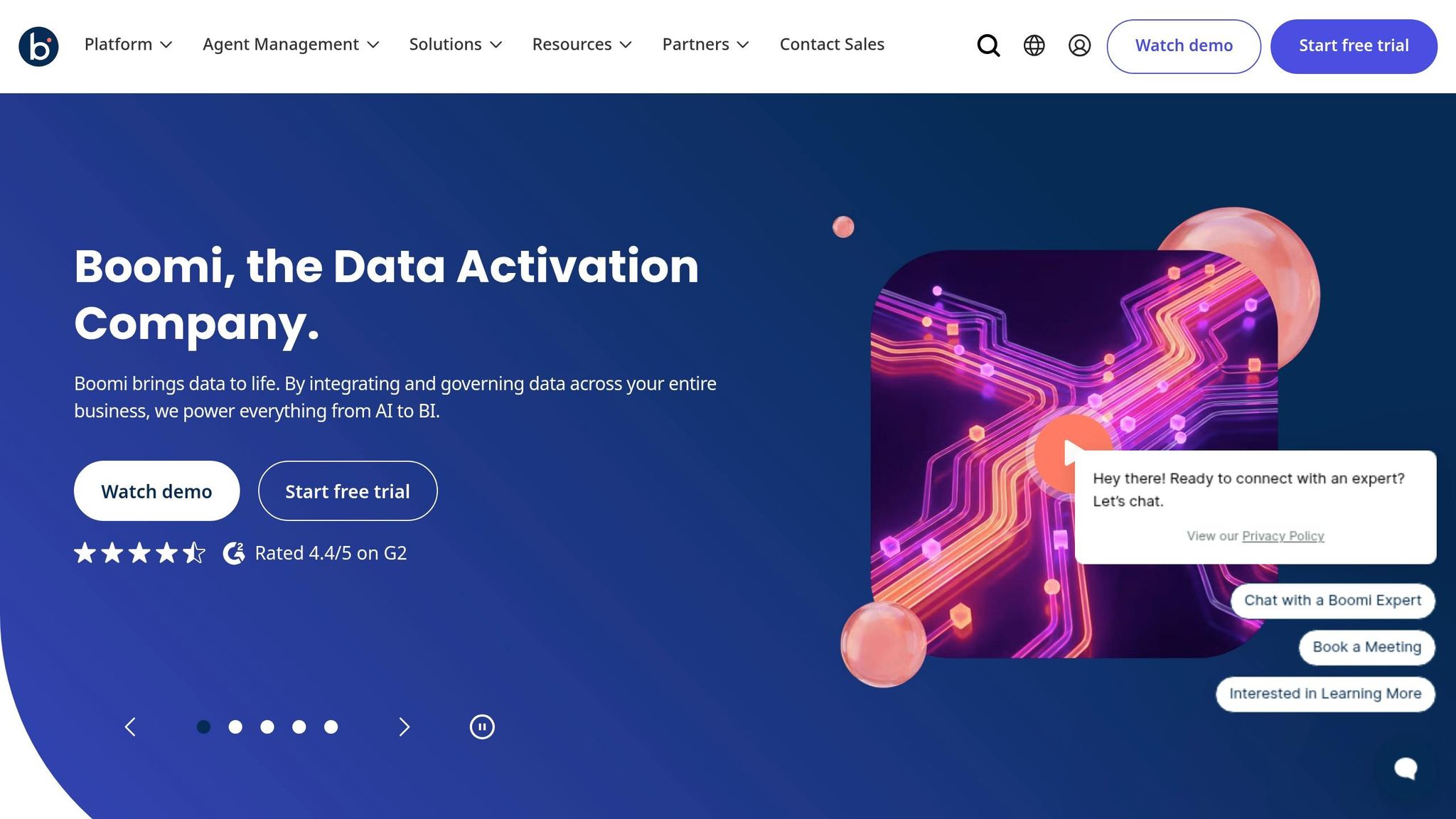
Boomi stands out as a proprietary low-code platform with a strong focus on data mapping and integration. It has been a consistent Leader in the Gartner Magic Quadrant for iPaaS for an impressive 10 years in a row. With over 20,000 customers and a community of 100,000 members, Boomi has firmly established itself as a trusted name in this space.
Data Mapping Features
Boomi simplifies integration tasks with its drag-and-drop interface, which uses visual shapes for mapping, encryption, and lookups. One of its standout tools, Data Map Extensions, allows users to override or add fields to flat file profiles during deployment - without altering the original process. This feature is available for XML or flat file profiles with single-record formats, while the original mapping remains read-only [[18]](https://help.boomi.com/docs/Atomsphere/Integration/Process building/c-atm-Data_Map_Extensions_126d6c7d-71d1-4839-b1e7-586147f826d1). Users frequently highlight its ease of use, and its SAP connector is especially appreciated for streamlining enterprise integrations. Some organizations have even reported achieving a 410% return on investment with Boomi.
Integration Capabilities
Boomi provides over 240 pre-built connectors, covering major platforms like SAP for ERPs, Salesforce for CRMs, and a range of SaaS applications. Its distributed architecture, known as Atoms, supports hybrid (cloud and on-premise), real-time, and batch integrations, giving users flexibility across environments. Additionally, its GenAI feature automates workflows and pipeline development, helping businesses achieve faster results. These features are complemented by a strong focus on security.
Security and Compliance
Boomi is equipped with certifications such as HIPAA, GDPR, SOC, FedRAMP, and ISO, making it an excellent option for industries that require strict compliance, like government and finance. Its clustered runtime configurations ensure high availability and load balancing, which are crucial for mission-critical operations.
Scalability and Pricing
Boomi offers a tiered pricing system, starting with a pay-as-you-go plan at $99 per month plus $0.05 per Boomi Message. For mid-sized companies, annual costs typically range from $25,000 to $75,000. Usage is tracked through Boomi Data Units (BDUs), with credits varying by transfer type. For larger data loads and parallel processing, the Enterprise tier provides enhanced capabilities. While the pricing may be a hurdle for smaller teams, one customer managed to cut Boomi costs by 28% in their first year by optimizing licenses. The platform enjoys strong user reviews, earning a 4.4/5 rating on G2 and 4.7/5 on Gartner.
5. SnapLogic
SnapLogic uses AI-powered automation to simplify data mapping, earning recognition as a "Visionary" in the 2025 and 2026 Gartner Magic Quadrants for Data Integration Tools and iPaaS. A Forrester study highlighted the platform's impressive performance, delivering a 181% ROI and generating over $3.3 million in benefits within three years, with a payback period of less than three months.
Data Mapping Features
At the heart of SnapLogic's data transformation capabilities is the Mapper Snap, a tool designed with a drag-and-drop interface, JavaScript-like expressions, and AI-generated recommendations. AutoLink AI Mapping further simplifies the process by using AI to suggest field pairings through exact string matching, fuzzy matching, and historical data analysis. It even includes a star-rating system to indicate the confidence level of its suggestions. For users who prefer natural language input, SnapGPT acts as an AI assistant, generating mapping expressions and pipeline configurations from simple prompts.
Additional controls like "Null-safe access", which prevents errors when source paths are missing, and "Pass-through", which retains original data alongside transformations, add flexibility and reliability to the process. These tools integrate effortlessly into SnapLogic's broader ecosystem of features.
Integration Capabilities
SnapLogic provides over 800 pre-built "Snaps" (connectors) and more than 300 standard connectors tailored for data pipelines. In 2025, Hewlett Packard Enterprise successfully connected 1,800 applications using SnapLogic, cutting support overhead by more than 25%.
Swati Oza, Director of IT Emerging Technology, Data Integration, and ML at HPE, stated, "It takes us minutes to deploy integrations across 1,800 applications with SnapLogic. We've also been able to reduce support overhead and costs by over 25%".
The platform's Snaplex architecture offers flexibility, with deployment options like Cloudplex (managed by SnapLogic) or Groundplex (on-premises or private cloud) to meet specific data residency needs. Additionally, the Ultra Tasks feature ensures pipelines remain active for real-time document processing.
Security and Compliance
SnapLogic employs a stateless architecture, processing customer data in the data plane while storing only metadata in the control plane. The platform meets stringent compliance standards, including SOC 1 Type 2, SOC 2 Type 2, SOC 3, HIPAA-HITECH, GDPR, and CCPA. It also offers robust encryption options, such as disk-level and account-level encryption, and supports "Bring Your Own Key" (BYOK) for added data security. Authentication options include OAuth 2.0, OpenID, Multi-Factor Authentication (MFA), and Single Sign-On (SSO) through providers like Okta, Ping, and Active Directory.
Pricing Models
SnapLogic operates on a subscription-based pricing model, offering a 14-day free trial and optional add-ons like Ultra Tasks for handling high-volume APIs. Although pricing is quote-based and can increase with usage, many users find it more straightforward compared to the often opaque pricing of legacy tools. The platform has earned a ProPicked Score of 8.2/10 (Very Good) based on 1,100 reviews as of March 2026. Users have praised its powerful core features and AI-driven tools, though some mention a learning curve for mastering advanced functionalities.
Strengths and Weaknesses
This section provides a concise comparison of the strengths and weaknesses of each platform, focusing on their data mapping capabilities.
Integrate.io offers a fixed-fee pricing model starting at around $1,999/month, which eliminates the stress of usage-based billing. It features Change Data Capture with sub-60 second latency and more than 220 pre-built transformations. However, debugging can be challenging due to limited error logs, and the interface can become cluttered when managing highly complex pipelines.
Talend shines with its ecosystem of over 1,000 connectors, solid data governance tools, and an open-source option. It performs well in Big Data processing with Spark, but its Java-based architecture requires advanced developer skills, leading to a steep learning curve.
Informatica uses its AI-powered CLAIRE engine to automate processes, offering scalability for enterprise-level tasks and strong metadata management. On the downside, its high cost and complex interface necessitate specialized training.
Boomi focuses on speed and community insights, leveraging mapping suggestions from a customer base of over 20,000 and providing robust API management. However, its pricing may be too high for small and medium-sized businesses (SMBs), and it lacks granularity for intricate transformations.
SnapLogic processes approximately 2.7 trillion documents each month and uses AI tools to recommend pipeline configurations. It offers real-time streaming and over 700 pre-built "Snaps", but users have noted performance bottlenecks when handling large data volumes.
The table below summarizes the main strengths, limitations, and ideal use cases for each tool:
| Tool | Key Strengths | Key Limitations | Best For |
|---|---|---|---|
| Integrate.io | No-code UI; 220+ pre-built transformations; fixed-fee pricing; 24/7 support | Limited error logs; cluttered UI for complex pipelines | Mid-market companies; E-commerce; HIPAA/GDPR compliance |
| Talend | 1,000+ connectors; strong data profiling/governance; open-source option | Steep learning curve; Java-based architecture; complex UI | Enterprise data lakes; Big Data (Spark) processing |
| Informatica | AI-driven automation; scalable; robust metadata management; cloud integration | High cost; complex interface; requires training | Large enterprises; Government and Finance sectors |
| Boomi | Rapid deployment; community-driven mapping; strong API management | High pricing for SMBs; limited transformation granularity | Hybrid cloud environments; ERP-to-CRM workflows |
| SnapLogic | AI-driven pipeline suggestions; real-time streaming; 700+ pre-built "Snaps" | Performance issues with large data volumes; intricate pricing | Real-time data processing; AI-enhanced integrations |
Mid-market companies have reported savings of 34% to 71% by adopting Integrate.io's unlimited pricing model compared to older tools. Additionally, SnapLogic claims a 498% ROI with a payback period of under six months. Ultimately, the best choice depends on factors like technical expertise, budget, and specific data mapping needs.
Conclusion
When choosing a low-code data mapping tool, focus on your team's technical expertise, budget constraints, and scalability requirements. For mid-market companies, Integrate.io offers a fixed-fee model at $1,999 per month, which helps avoid unexpected usage-based costs. A great example of its success is the Leukaemia Foundation of Australia, which achieved a 90% boost in operational efficiency using this platform.
For enterprises handling large-scale data and complex workflows, priorities shift toward advanced features and scalability. Informatica stands out for its AI-driven automation, while SnapLogic offers unified application and data integration. Both platforms, however, require custom pricing discussions. These tools are often favored by major enterprises for their ability to expand data ecosystems without incurring usage-based fees. Meanwhile, Talend is ideal for teams requiring extensive transformation capabilities with an open-source framework, and Boomi excels in hybrid cloud setups with fast deployment and strong API management features.
Before fully committing to a platform, test it with realistic data volumes - at least 10,000 records. This step is vital because 25% to 30% of no-code projects face costly rewrites within two years due to performance limitations. Migration costs can range from $50,000 to $250,000. Additionally, if your organization operates in a regulated industry like healthcare or finance, ensure the platform complies with SOC 2, HIPAA, and GDPR standards to avoid expensive audits.
Robust testing and adherence to compliance standards are crucial for maximizing the benefits of low-code platforms. Companies transitioning from custom pipelines to low-code solutions report up to 70% cost savings and deployment speeds that are 3 to 5 times faster. For further assistance in selecting the best platform - whether it's Integrate.io, Talend, Informatica, Boomi, or SnapLogic - visit the Low Code Platforms Directory. This resource provides detailed filtering options for AI, automation, CRM, and data integration tools to help you make an informed decision.
FAQs
How do I choose between fixed-fee and usage-based pricing?
When choosing between fixed-fee and usage-based pricing for low-code data mapping tools, it's important to think about how you use the tool and what your budget allows.
- Fixed-fee pricing is great if your usage is steady. It gives you predictable costs, making it easier to plan your expenses.
- Usage-based pricing charges based on how much you actually use the tool. This can be a flexible option if your usage varies or is on the lower side, but it might lead to unpredictable costs.
Also, don’t overlook the long-term expenses. Hidden fees and the cost of support can add up over time. Balancing these factors will help you determine which pricing model aligns better with your financial and operational priorities.
What data volume should I test before committing to a tool?
When testing, use data volumes that mirror your usual or anticipated workload. This approach helps confirm that the tool can manage your data size effectively and meet your performance needs before you fully commit.
Which tool fits regulated industries like HIPAA or GDPR?
Tools tailored for regulated industries, such as those governed by HIPAA or GDPR, often come equipped with features to support compliance. These include audit trails, data governance capabilities, and privacy-focused tools. For instance:
- Informatica PowerCenter: Known for its GDPR compliance features, it offers metadata-driven data lineage to ensure transparency and accountability.
- Secure Privacy: Designed to address global privacy regulations, including GDPR and CPRA, helping organizations manage consent and compliance efficiently.
- Jitterbit: Provides secure integration solutions that align with standards like HIPAA, GDPR, and ISO 27001.
These platforms make compliance a central part of their functionality, helping businesses meet strict regulatory requirements.