Low-code platforms are transforming how IT and business teams collaborate, addressing longstanding issues in software development. These platforms enable faster app creation through visual tools, reducing reliance on manual coding. With a projected shortage of 1.2 million developers in the U.S. by 2026, low-code solutions empower business users (or "citizen developers") to build applications quickly, while IT focuses on security and governance.
Key points:
- $2.4 trillion lost in 2022 due to poor IT-business collaboration and software issues.
- 65% of software builders by 2025 will be non-engineers, including business roles.
- Low-code platforms cut development time by up to 90% and improve integration with pre-built connectors.
- IT ensures compliance and security while business teams handle app logic and design.
Low-code complements traditional coding by accelerating internal tools and prototypes while leaving complex systems to IT. Companies like Rolls-Royce and ClickUp have saved millions using this approach. The result? Faster solutions, reduced costs, and better teamwork.
Using Low-Code to Fuel Innovation & Collaboration
sbb-itb-33eb356
1. Traditional Development Methods
In traditional development, IT and business teams often operate in silos - a gap that low-code platforms aim to bridge. Business experts typically document their needs in extensive requirement files, but when these are handed off to IT, delays are almost inevitable. The core issue? Business teams focus on workflows and outcomes, while IT deals in code and technical specifications. As Paulina Florax explains:
"When you don't speak a common language, it's tough to work together. Translating business ideas to IT requirements is impossible without the proper comms".
Collaboration
Traditional methods keep business and IT workflows separate. Business units often manage their own priority lists and digitization plans, leading to conflicting goals and a lack of strategic alignment. Feedback loops are fragmented, making it hard to collect and prioritize user suggestions effectively. This disconnection has fueled the rise of Shadow IT, where business users, frustrated by IT delays, create their own solutions without proper oversight. With IT backlogs stretching up to 12 months, the temptation to bypass IT grows. Mike Mason, Chief Technology Officer at ThoughtWorks, highlights the risks:
"Without skilled developers and IT experts overseeing what business teams use... you get 'software without strategy': lines of business continuously solving problems with bespoke point solutions, with little-to-no cohesion or interoperability".
Development Speed
The linear nature of traditional development often slows everything down. Around 42% of business users face delays waiting for engineering resources to kick off their projects. Hand-coding and testing take time, leaving 25% of business problems unresolved due to IT backlogs. With rigid processes and a looming shortage of 1.2 million developers by 2026, delays are inevitable - one-third of projects are postponed by six months or more.
Integration Capabilities
Today’s enterprises rely on 1,000+ cloud applications on average, but traditional development struggles to connect them seamlessly. IT teams often resort to hand-coding custom API connections, which can break whenever vendors update their APIs, leading to ongoing maintenance headaches. As Tray.ai points out:
"Integration projects can quickly turn into an endless burden of internal builds across internally used tools which eventually break when vendors update APIs, requiring constant maintenance".
Legacy systems like ERP and CRM further complicate matters, as they often lack modern connectivity options, creating data silos that traditional methods can’t easily resolve. Microsoft captures the challenge well:
"Traditional software development may not move fast enough today to match the speed of change in business".
Governance and Security
The separation of roles in traditional development makes it hard for IT to oversee what business users build independently. Without proper governance, departments frequently create redundant applications that bypass security protocols. The rush to meet deadlines often leads to technical debt - software launched with known flaws that later require costly rework, further straining IT resources. Only 43% of IT professionals in large enterprises report effective use of agile principles, largely because siloed environments make true collaboration difficult.
These limitations highlight why low-code development platforms are gaining traction - they promise faster integration, improved collaboration, and better governance.
2. Low-Code Development Platforms
Low-code platforms bring IT and business teams together in what are known as fusion teams - groups where business users and IT professionals collaborate closely. These platforms tackle the inefficiencies of traditional development methods by using drag-and-drop tools for app design, allowing business users to contribute directly, while IT focuses on tasks like security and database integration. This approach bridges the communication gap that often arises during traditional handoffs. Gary Plotkin, Global Platform Leader at KPMG, puts it this way:
"The fusion team is the control point that ensures that business demand and ideation meet IT controls to ensure corporate design standards and resiliency."
This collaborative model has proven effective in improving teamwork, speeding up development, and maintaining governance.
Collaboration
Fusion teams have shown impressive results in practice. For instance, at BMW Brilliance's Dadong Plant in 2023, the logistics department used the Mendix low-code platform to drive digital transformation. After just one month of training, 40 employees from logistics, procurement, and mechanical departments became certified developers. Within three months, they launched three digital applications, including a Vendor Managed Inventory (VMI) app that eased warehouse pressures. Similar efficiency gains are seen in customer experience transformation projects. The outcome? A 30% reduction in development time and a 50% drop in human resource costs. Additionally, data shows that 4 out of 5 U.S. companies now use low-code platforms for application development.
Development Speed
Low-code platforms dramatically cut development times. With visual interfaces and pre-built components, applications can be developed up to 90% faster compared to traditional methods. This efficiency helps tackle the lengthy delays - sometimes up to 12 months - common in conventional IT projects. Instead, low-code solutions can go from prototype to deployment in just weeks. The growing interest in these platforms is evident, with investments in low-code tripling since 2020. By 2030, the market is expected to surpass $190 billion.
Integration Capabilities
Modern low-code platforms come equipped with modular architectures and extensive libraries of pre-built connectors, making it easier to integrate with popular tools and legacy systems. These connectors handle tasks like authentication and system-specific logic automatically, removing the need for manual API coding. They support protocols such as REST, SOAP, OData, and SAP, allowing seamless connections with databases and file systems. Users can map data visually without writing code, and advanced platforms even let developers add custom scripts in JavaScript or Python for more intricate tasks. This streamlined approach can cut API integration and maintenance costs by 50% to 70% compared to traditional coding methods.
Governance and Security
Low-code platforms also prioritize governance and security to ensure compliance and protect sensitive data. IT teams can set predefined rules and role-based access controls, maintaining oversight throughout the development process. Platforms typically provide separate environments for development, testing, and production, ensuring experimental work doesn’t interfere with live systems. Administrators can enforce Data Loss Prevention (DLP) policies to manage data flows securely, while Single Sign-On integration with enterprise identity providers further strengthens security. A prime example is Microsoft's internal "Success Hub" project, where over 20 multi-role teams co-developed more than 50 business applications within a single Microsoft Dataverse instance. This setup supported thousands of active users monthly while adhering to strict IT governance.
As Microsoft documentation highlights:
"Governance is the answer. It aims to enable business groups to focus on solving business problems efficiently while complying with IT and business compliance standards."
Advantages and Disadvantages
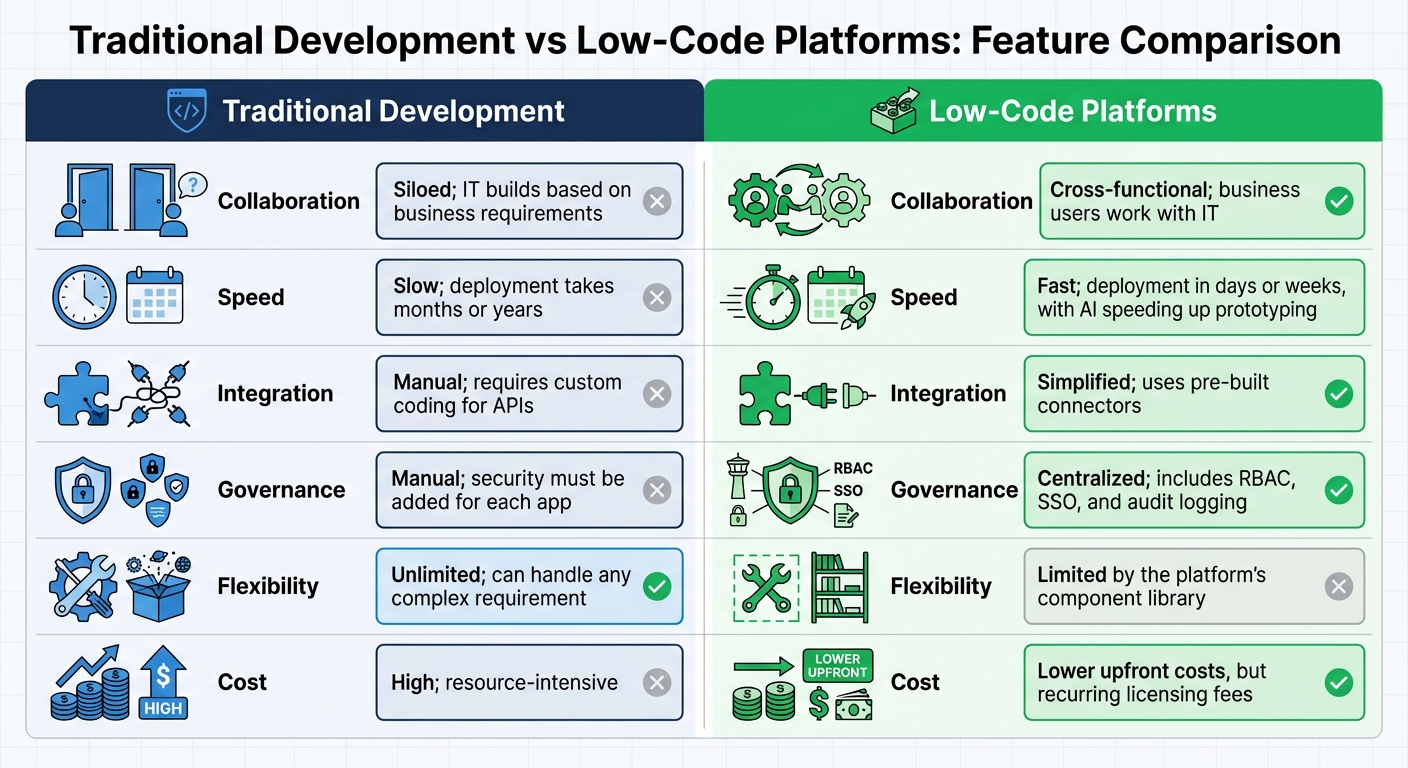
Traditional Development vs Low-Code Platforms: A Feature Comparison
Understanding the trade-offs between traditional development and low-code platforms is essential for bridging the gap between IT and business needs. Traditional development offers unmatched customization and flexibility, but it comes with high costs, long timelines, and a growing shortage of skilled developers.
Low-code platforms, on the other hand, speed up delivery with visual tools and encourage collaboration between IT teams and non-technical users. For example, 51% of low-code users report solving problems within days or weeks, and 80% can go from identifying an issue to resolving it without needing extra IT resources. However, low-code platforms aren’t perfect. They can struggle with handling highly complex or resource-heavy tasks and may lead to vendor lock-in, where migrating applications requires starting from scratch - making long-term scalability and collaboration more challenging.
Cost is another factor influenced by these technical differences. Traditional development requires expensive, specialized talent, while proprietary low-code platforms often operate on subscription models. Pricing can range from $8 per user per month for tools like Zoho Creator to $998 per month for Mendix's single-app plans. Still, ThoughtWorks analysts caution:
"Choosing to adopt low code because you have a shortage of development and coding skills in your organization can lead to trouble... you get 'software without strategy'".
Here’s a quick comparison of the two approaches:
| Feature | Traditional Development | Low-Code Platforms |
|---|---|---|
| Collaboration | Siloed; IT builds based on business requirements | Cross-functional; business users work with IT |
| Speed | Slow; deployment takes months or years | Fast; deployment in days or weeks, with AI speeding up prototyping |
| Integration | Manual; requires custom coding for APIs | Simplified; uses pre-built connectors |
| Governance | Manual; security must be added for each app | Centralized; includes RBAC, SSO, and audit logging |
| Flexibility | Unlimited; can handle any complex requirement | Limited by the platform’s component library |
| Cost | High; resource-intensive | Lower upfront costs, but recurring licensing fees |
Low-code platforms often complement traditional development rather than replace it. They’re ideal for rapid prototyping, internal tools, and free low-code workflows, while traditional development remains the go-to for building core enterprise systems that demand extensive customization and scalability.
Conclusion
Bridging the gap between IT and business teams doesn’t have to be a long-term challenge. Low-code platforms provide a shared digital workspace where both groups can collaborate in real-time - prototyping, iterating, and building solutions together. This eliminates the traditional back-and-forth process, where business teams submit requirements and wait months for a solution that might not fully meet their needs. Instead, these platforms use intuitive visual tools to foster collaboration and speed up development.
Low-code and traditional development aren’t competing approaches - they work hand-in-hand. As ThoughtWorks analysts put it:
"Where can low code best support and complement our expert developers?"
Low-code is ideal for internal tools, rapid prototypes, and edge applications where speed takes priority over complex customization. Meanwhile, traditional development remains the go-to for core systems that require deep scalability and intricate architecture. This combined strategy aligns IT and business goals, reshaping how organizations approach development.
The results speak for themselves. In July 2025, ClickUp’s Go-To-Market team built six custom AI tools using Retool, saving $200,000 annually and avoiding the need for additional hires. Rolls-Royce took a similar approach, empowering over 1,000 non-IT employees to become "citizen developers" starting in 2019. By 2022, this initiative delivered $10–13 million in cost efficiencies by enabling domain-specific problem-solving.
To ensure success, establish clear governance rules. IT should oversee security, authentication, and data permissions, while business users operate within those boundaries. Start small with a pilot project to demonstrate the platform's value. Also, make sure your data is properly organized and ready for integration. Without proper oversight, you risk creating:
"software without strategy"
This integrated approach not only strengthens cross-functional teamwork but also ensures measurable outcomes.
Data reveals that 51% of builders can solve problems in days or weeks, and 80% do so without needing extra IT support. Low-code platforms offer a scalable way to expand your team’s capabilities while keeping IT in control of critical aspects. To explore options tailored to your needs, check out the Low Code Platforms Directory, where you can filter by functionality, industry, and specific use cases.
FAQs
What should IT govern in low-code, and what can business teams own?
In low-code development, IT plays a crucial role in overseeing security, compliance, and platform management. This includes setting clear policies, reviewing applications, and safeguarding data. These steps help prevent shadow IT and ensure that all solutions align with enterprise standards.
Meanwhile, business teams can take ownership of the specific applications and workflows they create to address their immediate needs. However, their efforts must operate within the governance framework established by IT. This ensures responsible development, proper integration, and ongoing maintenance. By balancing innovation with oversight, organizations can empower teams while maintaining control.
How do you prevent shadow IT and app sprawl with citizen developers?
To tackle shadow IT and app sprawl effectively, organizations need governance frameworks that strike the right balance between control and flexibility. Start by establishing clear policies that outline who is authorized to develop apps, which platforms are approved, and the procedures for reviewing solutions.
Empowering citizen developers is key, but it should come with support. Offer training programs, standardized workflows, and clear compliance guidelines to ensure they can innovate responsibly.
A centralized Low-Code Center of Excellence (CoE) can be a game-changer. It acts as a hub to ensure all apps align with enterprise standards, minimizing risks while encouraging thoughtful and secure app development.
When should you choose traditional coding instead of low-code?
Traditional coding works best for projects that demand complex, highly tailored, or performance-sensitive solutions - areas where low-code platforms might fall short. It's also a stronger option when strict security measures, compliance requirements, or precise architectural control are non-negotiable. While low-code speeds up development, traditional coding provides more flexibility and scalability, making it the go-to choice for mission-critical systems, intricate integrations, or projects requiring long-term upkeep.